
4 November 2026
6 topics in this edition
04th Nov 2026 News
On the Arunachal Frontier, Silence Is Not a Strategy
GS Paper II – India–China Relations
Context
Reported face-offs between the Indian Army and China's People's Liberation Army (PLA) at several locations along the Arunachal Pradesh frontier. Still, India's silence or ambiguous public statements may encourage incremental territorial changes by China.
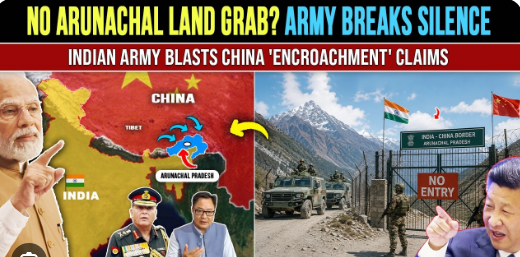
Understanding the geographical importance of Arunachal Pradesh

- Arunachal Pradesh is located in India's northeastern region.
- It shares an international boundary with China (Tibet), Bhutan and Myanmar.
- China refers to Arunachal Pradesh as Zangnan (South Tibet) and claims approximately 90,000 sq km of the territory.
- The McMahon Line, drawn during the 1914 Simla Convention, forms the basis of India's boundary position in the eastern sector.
- China does not accept the McMahon Line as the international boundary.
Geographical significance:
- Strategic access to the eastern Himalayas.
- Proximity to Tibet and the Tibetan Plateau.
- Importance of mountain passes, river valleys and high-altitude military routes.
- Security implications for the wider Northeast region.
Why is the LAC dispute difficult to resolve?

The Line of Actual Control (LAC) is the de facto line separating areas controlled by India and China. It is not a mutually agreed, demarcated international boundary.
| Sector | Geographical region | Major dispute |
|---|---|---|
| Western | Ladakh | Aksai Chin |
| Middle | Himachal Pradesh and Uttarakhand | Comparatively fewer disputes |
| Eastern | Arunachal Pradesh and Sikkim | China's claims over Arunachal Pradesh |
The 1959 Line versus the McMahon Line
- 1959 Line: China refers to its proposed line of actual control based on its November 1959 position.
- McMahon Line: The boundary alignment associated with the 1914 Simla Convention in the eastern sector.
- India rejects China's unilateral interpretation of the 1959 LAC.
- Accepting vague formulations such as "different perceptions" may weaken India's position when China attempts to alter the ground situation.
- It highlights the importance of the highest watershed principle in the eastern Himalayan boundary alignment.
Important India–China border agreements
| Agreement | Year | Main significance |
|---|---|---|
| Agreement on Maintenance of Peace and Tranquillity along the LAC | 1993 | Maintaining peace along the LAC |
| Agreement on Confidence-Building Measures in the Military Field | 1996 | Military restraint and confidence-building |
| Political Parameters and Guiding Principles Agreement | 2005 | Framework for a boundary settlement |
| Border Defence Cooperation Agreement (BDCA) | 2013 | Strengthening border cooperation |
Criticism for India's approach
- Strategic ambiguity: Repeated references to different perceptions may allow China to justify its patrols and territorial claims.
- Salami-slicing strategy: Small, incremental territorial advances may gradually change the ground situation.
- Limited transparency: Lack of clear public communication creates uncertainty about developments along the border.
- Ineffective negotiations: Repeated military and diplomatic discussions have not resolved all stand-offs.
- Weakening of negotiating position: Failure to clearly articulate India's position may allow China's claims to gain greater diplomatic visibility.
Way Forward
- Diplomatic clarity: Clearly communicate India's territorial position.
- Border infrastructure: Improve roads, bridges, tunnels, airstrips and communication networks.
- Military preparedness: Strengthen surveillance, logistics and high-altitude operational capabilities.
- Political-level engagement: Raise serious transgressions at the highest diplomatic and political levels.
- Map exchange: Revive the process of clarifying the LAC alignment.
- Confidence-building measures: Strengthen communication between border commanders and establish effective incident-prevention mechanisms.
- Strategic transparency: Inform Parliament and the public responsibly about major border developments.
UPSC Prelims Practice Question
Q. The term salami slicing, in the context of international relations, refers to:
- (A) Establishing a mutually agreed boundary through diplomatic negotiations.
- (B) Gradual acquisition of territorial or strategic advantages through small, incremental actions.
- (C) Withdrawal of troops from disputed areas under a peace agreement.
- (D) Formation of a joint military command between neighbouring countries.
UPSC Mains Practice Question
Q. Discuss the geographical and infrastructural challenges involved in securing India's eastern Himalayan frontier.
Jobs for Locals: How Feasible Is the Idea?
GS Paper II – India–China Relations
Core issue
“Jobs for locals” refers to policies that reserve or give preference to people belonging to a particular State or region in employment opportunities within that State. The issue has repeatedly returned to the national debate because several States have explored or enacted domicile-based preferences in private-sector employment.

Important examples:
- Haryana: The Haryana State Employment of Local Candidates Act, 2020 sought to reserve 75% of certain private-sector jobs for local candidates, initially for jobs paying up to ₹50,000 per month; the salary ceiling was later reduced to ₹30,000.
- Andhra Pradesh: The Andhra Pradesh Employment of Local Candidates in Industries/Factories Act, 2019 provided for 75% reservation for local candidates in specified industries and factories.
- Karnataka: In July 2024, the State Cabinet approved a Bill proposing 50% reservation for locals in management jobs and 75% in non-management jobs in the private sector. It was subsequently put on hold amid criticism.
What are the reservation provisions?
| Constitutional provision | Relevance |
|---|---|
| Article 14 | Equality before law and equal protection of laws. |
| Article 15(1) | Prohibits discrimination on grounds only of religion, race, caste, sex, place of birth or any of them. |
| Article 16(1) | Guarantees equality of opportunity in matters of public employment. |
| Article 16(2) | Prohibits discrimination in public employment on grounds including place of birth and residence. |
| Article 16(3) | Parliament may prescribe residence requirements for certain public employment. |
| Article 16(4) | Permits reservation for backward classes inadequately represented in State services. |
| Article 16(4A) | Enables reservation in promotion for SCs and STs under specified conditions. |
| Article 19(1)(d) and (e) | Right to move freely and reside and settle anywhere in India. |
| Article 19(1)(g) | Right to practise any profession or carry on any occupation, trade or business. |
| Article 38 | Directs the State to promote social, economic and political justice and reduce inequalities. |
| Article 39(a) | Directs the State to secure adequate means of livelihood for citizens. |
Important distinction: Article 16
- A State legislature cannot independently invoke Article 16(3) to impose a general residence requirement for public employment.
- The power is vested in Parliament.
- Article 16(4) is not a general provision for domicile-based reservation. It concerns backward classes that are inadequately represented in State services.
- Residence and place of birth are not identical concepts. However, a State cannot automatically convert domicile into a valid ground for excluding other Indian citizens from public employment.
Constitutional relevance
The debate involves two competing constitutional objectives:
A. Social and economic justice
- Address unemployment among local youth.
- Reduce regional inequalities.
- Ensure that local communities benefit from industrial development.
- Promote inclusive economic growth.
B. National unity and equality
- India follows the principle of single citizenship.
- Citizens have the right to move and work across the country.
- Employment opportunities should not be restricted arbitrarily by State boundaries.
- Excessive regional preferences may encourage linguistic and regional divisions.
The Constitution seeks to balance affirmative action with equality of opportunity. Reservation is a tool for substantive equality, not a general licence to discriminate against citizens from other States.
Important judicial cases
| Case | Year | Key principle |
|---|---|---|
| A.V.S. Narasimha Rao v. State of Andhra Pradesh | 1969 | Article 16(3) empowers Parliament to prescribe residence requirements; it cannot be used to create arbitrary regional preferences within a State. |
| Dr. Pradeep Jain v. Union of India | 1984 | Warned against excessive “sons of the soil” policies and narrow regional loyalties. The case primarily concerned admissions, not private-sector employment. |
| Indra Sawhney v. Union of India | 1992 | Generally established a 50% ceiling on reservation under Article 16(4), subject to exceptional circumstances. |
| Kailash Chand Sharma v. State of Rajasthan | 2002 | Residence alone cannot justify preferential treatment in public employment, whether at State, regional or district level. |
| P.A. Inamdar v. State of Maharashtra | 2005 | Recognised autonomy of unaided private professional educational institutions; relevant by analogy to the debate over private-sector autonomy, but not a direct employment-reservation ruling. |
| IMT Industrial Association v. State of Haryana | 2023 | Punjab and Haryana High Court struck down Haryana's 75% private-sector local employment law as unconstitutional. |
Major Challenges
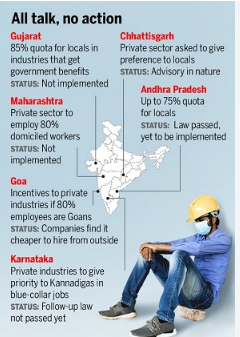
- Constitutional: Conflict with Articles 14, 16 and 19; may undermine equality and common citizenship.
- Economic: Restricts labour mobility, affects industrial competitiveness and may discourage investment.
- Administrative: Difficulties in verifying domicile, monitoring recruitment and granting exemptions.
- Social: Promotes regionalism, linguistic tensions and discrimination against migrant workers.
- Federal: Encourages inter-State competition and weakens economic integration and cooperative federalism.
Way forward
- Skill development: Align ITIs, polytechnics and universities with the actual requirements of local industries.
- Apprenticeship expansion: Encourage companies to provide structured training and employment pathways to local youth.
- Employment-linked incentives: Offer incentives to firms that voluntarily recruit and train local candidates, subject to constitutional safeguards.
- Transparent labour-market data: Identify skill shortages, unemployment patterns and district-level employment gaps.
- Improve education quality: Strengthen vocational education, digital skills and industry-oriented training.
- Promote labour mobility: Protect migrant workers' rights and ensure that employment opportunities remain open across India.
- Constitutional scrutiny: Any employment preference must have a valid legal basis, reasonable classification and compliance with fundamental rights.
UPSC Mains Practice Question
Q. “The demand for reservation of jobs for local residents reflects the tension between regional aspirations and constitutional nationalism.” Discuss.
How the Supreme Court Shaped Due Process in Death Penalty Cases
GS Paper II: Fundamental Rights | GS Paper III: Criminal Justice System
Context
The Supreme Court has strengthened procedural safeguards in death penalty cases, holding that extreme brutality alone cannot justify capital punishment. Sentencing must ensure fairness, equality and due process, considering both the crime and the convict's circumstances. This approach evolved through landmark judgments: Bachan Singh (1980), Manoj (2022) and Vasanta Sampat Dupare (2025).

Due Process in Death Penalty Cases
Due process means that the State must follow a fair, reasonable and constitutionally valid procedure before depriving a person of life or liberty.
In death penalty cases, it requires:
- Fair investigation and trial.
- Effective legal representation.
- Proper consideration of evidence.
- Separate and meaningful sentencing hearings.
- Examination of aggravating and mitigating circumstances.
- Consideration of the accused's possibility of reformation.
- Fair review and appellate procedures.
Evolution of Supreme Court Jurisprudence
The Supreme Court has developed death penalty safeguards through a series of landmark judgments.
| Year | Case | Major contribution |
|---|---|---|
| 1973 | Jagmohan Singh v. State of U.P. | Upheld the constitutional validity of the death penalty. |
| 1980 | Bachan Singh v. State of Punjab | Established the 'rarest of rare' doctrine. |
| 1983 | Mithu v. State of Punjab | Struck down mandatory death penalty under Section 303 IPC. |
| 1983 | Machhi Singh v. State of Punjab | Explained categories relevant to the rarest-of-rare test. |
| 2009 | Santosh Kumar Bariyar v. State of Maharashtra | Emphasised individualised sentencing and constitutional safeguards. |
| 2014 | Mohd. Arif v. Registrar, Supreme Court of India | Required open-court oral hearings in death penalty review petitions. |
| 2022 | Manoj v. State of Madhya Pradesh | Prescribed structured collection of mitigating information before sentencing. |
| 2025 | Vasanta Sampat Dupare v. Union of India | Recognised serious violations of sentencing safeguards as violations of fundamental rights. |
Landmark Judgments
A. Bachan Singh v. State of Punjab (1980)
The Supreme Court upheld the constitutional validity of capital punishment but introduced the Rarest of Rare Doctrine.
Key principles:
- Life imprisonment must be the rule and death penalty the exception.
- Death penalty can be imposed only in the rarest of rare cases.
- Courts must consider both aggravating and mitigating circumstances.
- Death sentence can be awarded only when the alternative option of life imprisonment is unquestionably foreclosed.
- The court must provide special reasons for imposing the death penalty.
Constitutional significance: Restricted arbitrary judicial discretion in capital punishment.
B. Manoj v. State of Madhya Pradesh (2022)
This judgment strengthened the requirement to collect information about the accused before imposing the death penalty.
The Supreme Court directed courts to obtain relevant information about:
- Psychological and psychiatric condition of the accused.
- Probation officer's report.
- Conduct and behaviour in prison.
- Family and socio-economic background.
- Educational and employment history.
- Possibility of reformation and rehabilitation.
Significance: Sentencing must examine the circumstances of the offender, not merely the seriousness of the crime.
C. Vasanta Sampat Dupare v. Union of India (2025)
In its judgment dated 25 August 2025, the Supreme Court strengthened the constitutional status of the procedural safeguards laid down in Manoj case.
Major findings:
- Failure to follow mandatory sentencing safeguards can violate Articles 14 and 21.
- Non-compliance is not merely a procedural irregularity.
- The Court set aside the death sentence and directed a fresh sentencing hearing.
- Article 32 can be invoked in appropriate cases even after the death sentence has attained finality, where a serious constitutional violation is established.
- The benefit of the new sentencing safeguards can extend retrospectively to eligible death-row prisoners.
Important distinction: The Court did not reopen the finding of guilt; it reopened the sentencing process.
Gap Between Judicial Guidelines and Trial Court Practice
The problem is not merely the absence of legal safeguards; it is also their inadequate implementation.
According to the Square Circle Clinic's 2026 report:

Major Challenges
- Procedural non-compliance: Trial courts may fail to follow Supreme Court sentencing guidelines.
- Inadequate legal aid: Poor and marginalised accused may lack effective legal representation.
- Lack of mitigation evidence: Personal history, mental health and socio-economic circumstances may not be properly investigated.
- Time constraints: Sentencing hearings conducted too quickly restrict meaningful examination of evidence.
- Irreversibility: An execution cannot be reversed if a wrongful conviction is subsequently discovered.
- Uneven judicial application: Different courts may interpret the rarest-of-rare doctrine differently.
Way Forward
- Strict implementation of Manoj and Aman Singh guidelines.
- Strengthen legal aid through specialised death penalty defence teams.
- Ensure independent psychological and psychiatric assessments.
- Develop standardised mitigation-investigation procedures through NALSA.
- Provide sufficient time between conviction and sentencing.
- Strengthen forensic investigation and prevent wrongful convictions.
- Develop a structured framework for assessing rehabilitation and reformation.
- Consider a comprehensive legislative framework for capital sentencing.
Q. "In death penalty cases, procedural fairness is as important as substantive justice." Explain with reference to recent Supreme Court judgments.
PRELIMS POINTERS
Contempt of Court
GS Paper II – Polity and Governance
Meaning

Contempt of Court refers to acts that undermine the authority of courts, disobey judicial orders or obstruct the administration of justice.
Objective: To protect judicial of law independence and uphold the rule.
Constitutional and Legal Provisions
| Provision | Key Feature |
|---|---|
| Article 129 | Supreme Court can punish for contempt of itself. |
| Article 215 | High Courts can punish for contempt of themselves. |
| Article 19(2) | Permits reasonable restrictions on free speech in relation to contempt of court. |
| Contempt of Courts Act, 1971 | Defines and regulates contempt proceedings. |
Types of Contempt
A. Civil Contempt – Section 2(b)
Wilful disobedience of a court judgment, order, direction or breach of an undertaking given to a court.
B. Criminal Contempt – Section 2(c)
Any act or publication that:
- Scandalises or lowers the authority of a court.
- Prejudices or interferes with judicial proceedings.
- Obstructs the administration of justice.
Important Provisions of the 1971 Act
| Section | Provision |
|---|---|
| Section 4 | Fair and accurate reporting of judicial proceedings |
| Section 5 | Fair criticism of judicial acts |
| Section 12 | Punishment for contempt |
| Section 13 | Substantial interference test; truth as a possible defence |
| Section 15 | Cognizance of criminal contempt |
| Section 20 | Limitation period of one year |
Punishment: Simple imprisonment up to 6 months, fine up to ₹2,000, or both.
Important Supreme Court Judgments
| Case | Principle |
|---|---|
| E.M.S. Namboodiripad (1970) | Examined criticism of the judiciary in relation to contempt. |
| P.N. Duda (1988) | Recognised the importance of fair criticism of judicial functioning. |
| In Re: Arundhati Roy (2002) | Contempt proceedings involving statements about the judiciary. |
| In Re: Prashant Bhushan (2020) | Examined social media criticism and criminal contempt. |
Issues and Challenges
- Vague provisions: Meaning of 'scandalising the court' may be interpreted broadly.
- Freedom of speech: Potential conflict with Article 19(1)(a).
- Judicial accountability: Risk of discouraging legitimate criticism.
- Social media: Rapid circulation of content may affect public perception and pending proceedings.
- Separation of powers: Need to balance judicial authority with democratic accountability.
Way Forward
- Clearly distinguish fair criticism from obstruction of justice.
- Use contempt powers proportionately and as a last resort.
- Protect freedom of speech and academic debate.
- Ensure transparency and procedural fairness.
- Prioritise compliance with judicial orders over unnecessary punitive action.
UPSC Prelims MCQs
Q. With reference to contempt of court in India, consider the following statements:
- The Supreme Court derives its contempt powers from Article 129.
- High Courts derive their contempt powers from Article 215.
- The Contempt of Courts Act, 1971 is the sole source of contempt jurisdiction of constitutional courts.
Which of the statements given above is/are correct?
- A. 1 and 2 only
- B. 2 and 3 only
- C. 1 and 3 only
- D. 1, 2 and 3
PM-Surya Ghar: Muft Bijli Yojana
Why in News?
The scheme aims to expand rooftop solar installations among residential households. As of 19 March 2026, over 26.19 lakh rooftop solar systems had been installed and ₹17,967.53 crore disbursed as Central Financial Assistance (CFA).
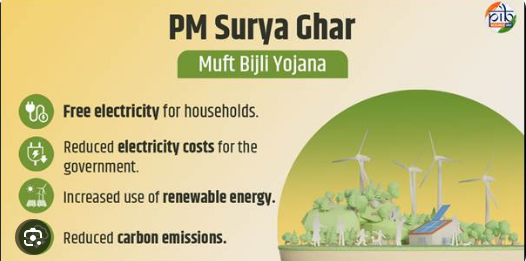
Basic Information
| Particular | Details |
|---|---|
| Launch | 13 February 2024 |
| Approved | 29 February 2024 |
| Ministry | Ministry of New and Renewable Energy (MNRE) |
| Type | Central Sector Scheme |
| Total outlay | ₹75,021 crore |
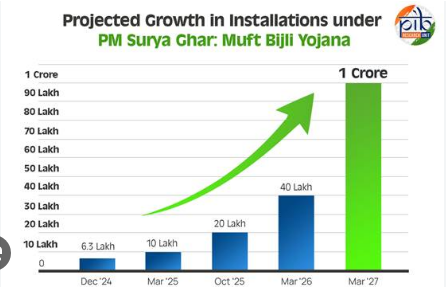
| Target | 1 crore households |
| Implementation period | Till FY 2026–27 |
| Main objective | Promote rooftop solar and provide up to 300 units of free electricity per month |
Major Features
- Central Financial Assistance (CFA)
| Rooftop solar capacity | Subsidy – General States |
|---|---|
| 1 kW | ₹30,000 |
| 2 kW | ₹60,000 |
| 3 kW or above | ₹78,000 (maximum) |
- Subsidy is transferred directly to the beneficiary's bank account through DBT.
- Special-category states/UTs receive higher CFA rates under the scheme.
- Subsidy is available for eligible residential rooftop solar installations.
B. Other Features
- National Portal for online applications.
- Registered vendors for installation.
- Net metering facility.
- Incentives to DISCOMs.
- Model Solar Villages in districts.
- Promotion of local solar manufacturing and employment.
Significance
- Energy security: Reduces dependence on conventional electricity sources.
- Clean energy: Promotes renewable energy and reduces carbon emissions.
- Economic benefits: Reduces household electricity expenditure.
- Employment: Generates opportunities in solar installation and maintenance.
- Decentralisation: Promotes distributed electricity generation.
Challenges
- High initial installation cost.
- Limited rooftop suitability in some households.
- Lack of awareness and technical knowledge.
- Delays in net metering and DISCOM approvals.
- Maintenance and performance issues.
UPSC Prelims MCQs
Q. With reference to PM-Surya Ghar: Muft Bijli Yojana, consider the following statements:
- It is implemented by the Ministry of New and Renewable Energy.
- It aims to install rooftop solar systems in one crore households.
- It provides central financial assistance to eligible residential consumers.
- It is exclusively meant for commercial and industrial establishments.
Which of the statements given above are correct?
- A. 1 and 2 only
- B. 1, 2 and 3 only
- C. 2 and 4 only
- D. 1, 2, 3 and 4