
31 October 2026
5 topics in this edition
31 October 2026 News
31 October 2026 News
Can India and China Coexist Peacefully?
UPSC Relevance: GS Paper II – International Relations
CONTEXT
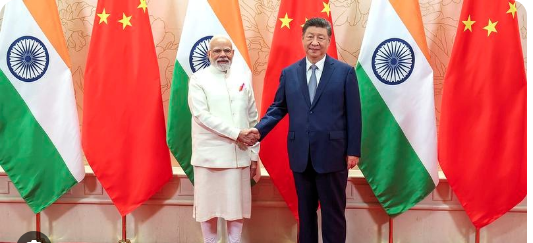
India and China need to develop a framework of peaceful coexistence despite unresolved border disputes, strategic competition and mutual distrust.
Background of India–China Relations
| Year | Important development |
|---|---|
| 1950 | India established diplomatic relations with the People's Republic of China. |
| 1962 | India–China border war; relations deteriorated. |
| 1988 | Prime Minister Rajiv Gandhi visited China; both sides agreed to pursue dialogue on the boundary issue. |
| 1993 | Agreement on maintaining peace and tranquillity along the LAC. |
| 1996 | Agreement on confidence-building measures in the military field along the LAC. |
| 2003 | Special Representatives mechanism established to discuss the boundary question. |
| 2005 | Agreement on Political Parameters and Guiding Principles for settlement of the boundary question. |
| 2012 | Working Mechanism for Consultation and Coordination (WMCC) established. |
| 2020 | Galwan Valley clash severely affected bilateral relations. |
| 2024–25 | Renewed efforts towards disengagement, dialogue and normalisation. |
Following major arguments against it:
A. Managed coexistence is possible
- India and China are two major neighbouring civilisations.
- Border disagreements should not make permanent hostility inevitable.
- Both countries have economic and strategic reasons to avoid conflict.
- Peaceful coexistence does not require immediate resolution of the boundary dispute.
B. Border disputes should not dominate the entire relationship
Every patrolling deviation should not automatically turn into a military face-off. Both sides need better communication and mechanisms to prevent local incidents from escalating.
C. The importance of the 1988 Rajiv Gandhi visit
The visit helped establish a framework in which the boundary dispute could be discussed separately while other areas of bilateral cooperation continued.
D. Avoid exaggerated threat perceptions
India should assess China's intentions carefully rather than viewing China as an existential threat. This is the author's assessment, not an established government position.
Major Areas of Cooperation
- Trade: China is an important trading partner and supplier of industrial inputs for India.
- Multilateral institutions: Both countries participate in BRICS, SCO and G20.
- Climate change: Cooperation is possible in climate negotiations and global environmental governance.
- Global South: Both countries engage with developing countries on international economic issues.
- Regional stability: Dialogue can reduce the risk of military escalation in Asia.
Major Challenges in India–China Relations
| Challenge | Explanation |
|---|---|
| Border dispute | Unresolved boundary and differing perceptions of the LAC |
| Military tensions | Troop deployment, infrastructure development and patrolling disputes |
| Trust deficit | 1962 war and 2020 Galwan clash |
| Strategic competition | China's growing influence in the Indian Ocean and South Asia |
| Trade imbalance | India's dependence on Chinese imports in several sectors |
| Pakistan factor | China's strategic and defence partnership with Pakistan |
| Regional influence | Competition over infrastructure, connectivity and influence in neighbouring countries |
Important Border Agreements and Mechanisms
| Agreement / Mechanism | Significance |
|---|---|
| 1993 Agreement | Maintenance of peace and tranquillity along the LAC |
| 1996 Agreement | Confidence-building measures in the military field |
| 2003 Special Representatives mechanism | Negotiations on the boundary question |
| 2005 Agreement | Political parameters and guiding principles for boundary settlement |
| 2012 WMCC | Consultation and coordination on India–China border affairs |
Important distinction:
- Special Representatives (SR): Focus on the overall boundary question and political settlement.
- WMCC: Coordinates communication and consultation on border-related affairs.
- LAC: The Line of Actual Control; it is not the same as a mutually agreed and demarcated international boundary.
Way Forward
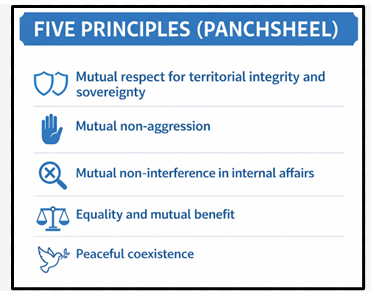
- Border peace: Maintain peace and tranquillity along the LAC through existing agreements.
- Diplomatic dialogue: Continue Special Representatives and WMCC meetings.
- Military communication: Strengthen communication between local commanders to prevent accidental escalation.
- Economic balance: Diversify critical supply chains while maintaining legitimate trade.
- Strategic preparedness: Strengthen border infrastructure, surveillance and defence capabilities.
- Mutual trust: Restore confidence through implementation of agreements and transparency.
- Multilateral cooperation: Explore cooperation through BRICS, SCO and other international platforms.
India's Position: Peace Along with Preparedness
India's approach needs to account for two realities:
- Cooperation: India and China have common interests in trade, - climate change and global governance.
- Competition and security: Unresolved territorial disputes and military tensions require vigilance and preparedness.
Mains Practice Questions
Q. “Peaceful coexistence with China must be accompanied by strategic preparedness.” Critically analyse. (15 Marks | 250 Words)
UPSC PRELIMS Practice Questions
Q. Consider the following statements about the Line of Actual Control (LAC):
- It represents the actual line separating areas under Indian and Chinese control.
- It is a fully demarcated and mutually agreed international boundary.
- Differing perceptions of the LAC can lead to patrolling disputes.
Which of the statements given above are correct?
- A. 1 and 2 only
- B. 1 and 3 only
- C. 2 and 3 only
- D. 1, 2 and 3
World Bank: Poverty & Equity Brief for India
UPSC Relevance: GS Paper II – Poverty; GS Paper III – Inclusive Growth; Essay
Why in News?
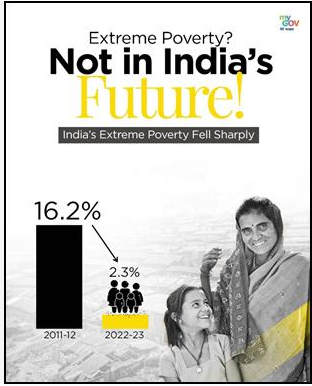
The World Bank released its India Poverty & Equity Brief, October 2026, reporting a substantial decline in poverty in India between 2011 and 2023.
Key Findings: Important Data
| Indicator | World Bank finding |
|---|---|
| Population below $4.20/day poverty line | 57.7% (2011)→ 16.1% (2023) |
| People lifted out of poverty | 496 million |
| Extreme poverty below $3/day | 27.1% → 2.6% |
| Rural poverty (2023) | 19.3% |
| Urban poverty (2023) | 8.6% |
| Population below $8.30/day line (2023) | About 80% |
Poverty thresholds are in 2021 Purchasing Power Parity (PPP) terms. The $4.20 threshold is the World Bank's lower-middle-income poverty line; $3 is the international extreme-poverty line. Figures compare 2011 and 2023 as reported in the brief.

Factors Responsible for Poverty Reduction
According to the report, important contributing factors include:
- Economic growth and consumption: Higher household consumption helped improve living standards.
- Employment growth: Employment opportunities increased, including women's employment.
- Social transfers: Food subsidies and welfare support helped protect household consumption.
- Rural development: Improvements in rural livelihoods contributed to poverty reduction.
Major Concerns Highlighted
- Rural–urban gap: Poverty remains higher in rural areas (19.3%) than urban areas (8.6%).
- Regional inequality: Poverty is concentrated in a belt of States extending from Uttar Pradesh to West Bengal, which accounts for about 57% of India's poor.
- Income inequality: Economic gains are not equally distributed.
- Wage disparity: Median earnings of the top 10% of workers were approximately 13 times those of the bottom 10% in 2023.
- Vulnerability: Households with low education, fewer assets and unstable employment remain at greater risk of poverty.
Poverty vs Inequality
| POVERTY | INEQUALITY |
|---|---|
| Lack of adequate income or consumption to meet a defined minimum standard | Unequal distribution of income, wealth or opportunities |
| Measured using poverty lines | Often measured using the Gini coefficient |
| Focuses on people below a specified threshold | Focuses on differences across the population |
Important: Poverty can decline while inequality remains high. A reduction in the number of poor people does not automatically mean that income and wealth are distributed equally.
Challenges for India
- Creation of secure and productive employment.
- Skill development and reduction of the education–employment mismatch.
- Reduction of regional disparities.
- Improvement in women's participation in quality employment.
- Better access to healthcare, education and social protection.
- Reducing wage and income inequality.
Way Forward
- Promote labour-intensive manufacturing and employment generation.
- Strengthen skill development and vocational education.
- Improve the quality of rural employment and agricultural productivity.
- Expand women's access to secure and paid employment.
- Improve health, education and nutrition services.
- Strengthen targeted social protection for vulnerable households.
- Focus on lagging States and districts through region-specific development policies.
UPSC Prellims Practice Question
Q. Consider the following statements about the Gini Index:
- It measures inequality in income or consumption distribution.
- A Gini value of zero represents perfect equality.
- A higher Gini value indicates greater equality.
Which of the statements given above are correct?
- A. 1 and 2 only
- B. 1 and 3 only
- C. 2 and 3 only
- D. 1, 2 and 3
Mains Practice Questions
Q. Discuss the major factors responsible for the decline in poverty in India, as highlighted by the World Bank's Poverty & Equity Brief. (10 Marks | 150 Words)
National Social Security Board for Unorganised, Gig and Platform Workers
UPSC Relevance: GS Paper II: Government policies | GS Paper III: Inclusive growth | Prelims
Why in News?
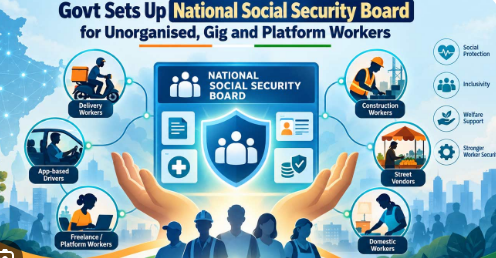
The Ministry of Labour and Employment notified the constitution of the National Social Security Board for Unorganised Workers and Gig & Platform Workers on 30 October 2026, under the Code on Social Security, 2020.
Understand the Three Categories of Workers
| Category | Meaning | Examples |
|---|---|---|
| Unorganised workers | Workers employed in the informal sector or not covered by the conventional organised employment framework | Agricultural labourers, construction workers, street vendors, domestic workers |
| Gig workers | Persons earning from work arrangements outside the traditional employer–employee relationship | Freelancers, independent service providers |
| Platform workers | Persons undertaking work through an online platform that connects them with customers | App-based delivery workers, cab drivers, online service providers. |
What Is the National Social Security Board?
- It is a statutory institutional mechanism under the Code on Social Security, 2020.
- Its purpose is to help the government develop and monitor social security measures for workers who often lack employment-linked benefits such as insurance, maternity protection, pensions and other welfare support.
- The Board is chaired by the Union Minister for Labour and Employment.
Constitutional and Legal Framework
The principal law is the Code on Social Security, 2020.
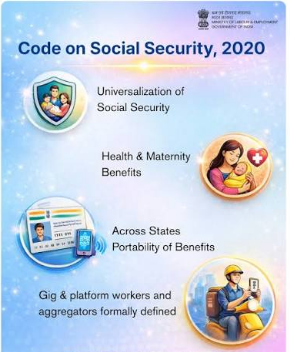
| Section | Important provision |
|---|---|
| Section 6 | National Social Security Board for unorganised workers |
| Section 109 | Social security schemes for unorganised workers |
| Section 110 | Funds for unorganised workers |
| Section 112 | Helpline and facilitation centres |
| Section 113 | Registration of unorganised, gig and platform workers |
| Section 114 | Social security schemes for gig and platform workers |
Major Functions of the Board
The Board performs the following functions:
- Recommend welfare schemes: Suggest suitable social security schemes for different categories of workers.
- Policy advice: Advise the Central Government on matters relating to implementation of the Code.
- Monitoring: Monitor social welfare schemes administered by the Central Government.
- State-level review: Review record-keeping functions performed by State Governments.
- Financial review: Examine expenditure from the relevant funds and accounts.
- Additional responsibilities: Perform other functions assigned by the Central Government.
What Social Security Benefits Can Workers Receive?
Under Section 114, the Central Government may frame schemes for gig and platform workers covering:
| Area | Possible benefits |
|---|---|
| Life and disability | Life insurance and disability protection |
| Accident insurance | Protection against work-related accidents |
| Health | Health insurance and medical support |
| Maternity | Maternity-related benefits |
| Old age | Pension and old-age protection |
| Childcare | Crèche facilities |
For unorganised workers, Section 109 also provides for schemes relating to life and disability cover, health, maternity, old-age protection and education.
Funding Mechanism: Role of Aggregators
Under Section 114, social security schemes may be funded through:
- Central Government contributions.
- State Government contributions.
- Contributions from aggregators.
- Beneficiary contributions, where specified.
- Corporate Social Responsibility (CSR) funds.
- Other permitted sources.
Aggregator contribution
The Code provides for an aggregator contribution:
- Minimum: 1% of annual turnover
- Maximum: 2% of annual turnover
- Subject to a ceiling of 5% of the amount paid or payable to gig and platform workers.
The actual applicable rate is to be notified by the Central Government. The Code also provides for notification of the commencement date of aggregator contributions.
Who are aggregators?
Companies or digital platforms that connect customers with service providers, such as ride-hailing, food delivery and other online service platforms.
Major Challenges
- Employment classification: Uncertainty over the employment relationship between platforms and workers.
- Income insecurity: Irregular earnings and lack of minimum income protection.
- Social security coverage: Difficulty ensuring effective insurance, pension and health coverage.
- Digital exclusion: Some workers may lack digital literacy or access to registration facilities.
- Funding and implementation: Ensuring timely contributions and adequate financial resources.
- Portability: Workers frequently change platforms, locations and employment arrangements.
- Worker representation: Ensuring that worker representatives can meaningfully participate in policy decisions.
Way Forward
- Establish a comprehensive and updated database of workers.
- Ensure simple registration and portable social security benefits.
- Strengthen coordination between Central and State Governments.
- Ensure transparency in aggregator contributions.
UPSC Prelims Practice Question
Q. With reference to the National Social Security Board, consider the following statements:
- It is provided for under the Code on Social Security, 2020.
- It recommends suitable social security schemes for unorganised workers, gig workers and platform workers.
- It is required to meet at least three times a year.
- It directly guarantees a pension to every registered gig worker.
Which of the statements given above are correct?
- A. 1 and 2 only
- B. 1, 2 and 3 only
- C. 2, 3 and 4 only
- D. 1, 2, 3 and 4
Mains Practice Question
- Explain the role of the National Social Security Board in extending social protection to India's unorganised and gig workforce. (10 Marks | 150 Words)
GSLV-F18 Launches NVS-03 Satellite
UPSC Relevance: Prelims Pointer
Why in News?
ISRO successfully launched GSLV-F18 carrying the NVS-03 navigation satellite on 30 October 2026 from the Second Launch Pad at Satish Dhawan Space Centre, Sriharikota.

About Mission
| Particular | Details |
|---|---|
| Launch vehicle | GSLV-F18 |
| Satellite | NVS-03 |
| Launch date | 30 October 2026 |
| Launch centre | Satish Dhawan Space Centre, Sriharikota |
| Launch pad | Second Launch Pad |
| Satellite mass | Approximately 2,232 kg |
| Target orbit | Geosynchronous Transfer Orbit |
| Launch vehicle flight number | 20th GSLV flight |
| Organisation | ISRO |
What Is NVS-03?
NVS-03 is a next-generation navigation satellite developed by ISRO to strengthen India's regional satellite navigation system.
Its major objectives are:
- Ensure continuity of navigation services.
- Improve availability and reliability of navigation signals.
- Strengthen India's independent positioning, navigation and timing capabilities.
- Support civilian, strategic and security applications.
What Is NavIC?
- NavIC = Navigation with Indian Constellation
- Earlier known as IRNSS (Indian Regional Navigation Satellite System), NavIC is India's indigenous regional satellite navigation system developed by ISRO.
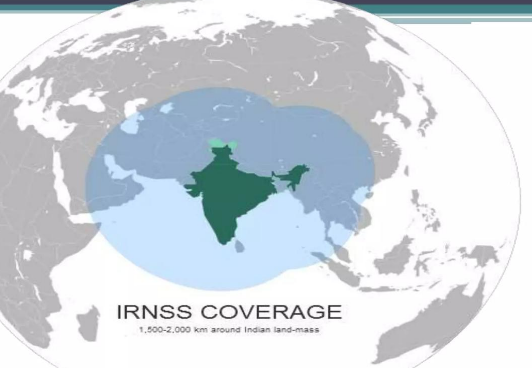
Key features:
- Provides Position, Navigation and Timing (PNT) services.
- Covers India and approximately 1,500 km beyond its boundary.
- Designed to provide independent navigation capability.
- Offers Standard Positioning Service (SPS) for civilian users and Restricted Service (RS) for authorised users.
NavIC vs GPS
| Basis | NavIC | GPS |
|---|---|---|
| Country India | USA | |
| Organisation | ISRO | US Space Force |
| Coverage | Regional | Global |
| Main purpose | Independent regional navigation | Global navigation |
| Full form | Navigation with Indian Constellation | Global Positioning System |
Applications of NavIC
- Transportation: Vehicle tracking and navigation.
- Fisheries: Navigation assistance for fishermen.
- Disaster management: Location tracking and emergency response.
- Defence: Strategic navigation and positioning.
- Agriculture: Precision farming and location-based services.
- Telecommunication: Accurate timing and synchronisation.
- Civil aviation: Navigation-related applications.
What Is GSLV?
- GSLV = Geosynchronous Satellite Launch Vehicle
- It is an Indian launch vehicle designed primarily to place heavier satellites into Geosynchronous Transfer Orbit (GTO).
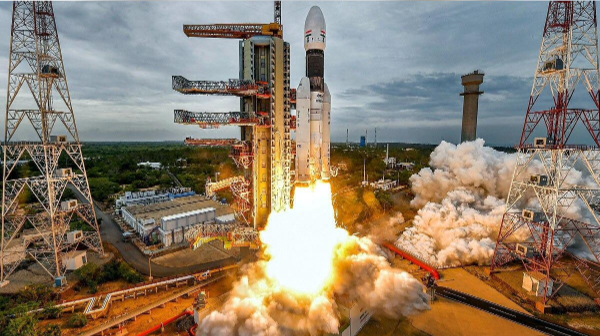
- Important facts:
- Developed and operated by ISRO.
- Uses a three-stage configuration.
- Its upper stage uses a cryogenic engine.
- GSLV-F18 was the 20th flight of GSLV.
- It placed NVS-03 into GTO.
UPSC Prelims Practice Question
Q. With reference to NavIC, consider the following statements:
- It is India's regional satellite navigation system.
- It provides coverage over India and approximately 1,500 km beyond its geopolitical boundary.
- It is operated by the United States Space Force.
- It provides positioning, navigation and timing services.
Which of the statements given above are correct?
- A. 1 and 2 only
- B. 1, 2 and 4 only
- C. 2, 3 and 4 only
- D. 1, 2, 3 and 4