
27 October 2026
6 topics in this edition
27th October news 1
27th October news
BEYOND KUDANKULAM’S FENCE: A CYBERSECURITY CHALLENGE
UPSC RELEVANCE: GS Paper III | GS Paper II
Why in the News?
A reported data breach involving a contractor associated with the Kudankulam Nuclear Power Plant highlighted cybersecurity vulnerabilities beyond the physical boundaries of critical infrastructure.
Core Argument of the Editorial- Cybersecurity must extend beyond a facility's physical boundaries to include contractors, suppliers, cloud service providers and every digital system handling sensitive information.
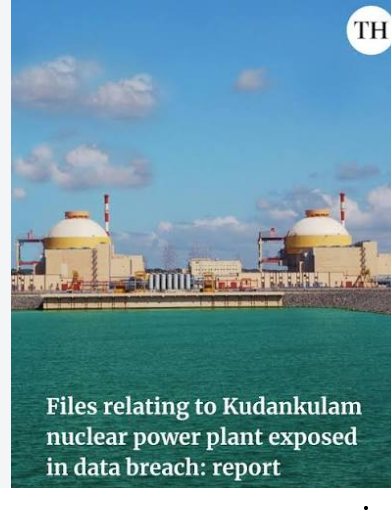
Background: Kudankulam Nuclear Power Plant
| Feature | Details |
|---|---|
| Location | Tamil Nadu |
| Operator | NPCIL |
| Administrative ministry | Department of Atomic Energy (DAE) |
| International cooperation | India–Russia nuclear cooperation |
| Russian partner | Rosatom |
| Significance | Major component of India's nuclear energy programme |
Why Is It Strategically Important?
- Supports India's electricity generation and energy security.
- Reduces dependence on fossil fuels when nuclear electricity displaces fossil-fuel-based generation.
- Contributes to India's long-term low-carbon energy transition.
- Represents critical infrastructure whose disruption could have economic and national-security implications.
What Happened in the Reported 2026 Data Breach?
According to reporting by Reuters and other media outlets, the incident involved contractor-related data rather than a confirmed compromise of the reactor's core control systems.
| Reported Details |
|---|
| Reported threat actor World Leaks |
| Type of incident Alleged data theft and publication |
| Reported data volume Approximately 14.3 GB |
| Number of files Nearly 19,000 |
| Contractor involved Reliance Infrastructure |
| Data-hosting provider Yotta Data Services |
| Investigation CERT-In involvement reported |
NPCIL's position The disclosed information concerned conventional facilities, not nuclear safety or security systems
Why Can Non-Nuclear Data Still Be Sensitive?
Even when reactor control systems remain secure, technical information about supporting infrastructure can potentially help an adversary:
- Understand the layout of facilities.
- Identify suppliers and contractors.
- Map relationships between systems.
- Prepare targeted phishing or social-engineering attacks.
- Identify possible weaknesses in maintenance or supply chains.
Key concept:
- Attack Surface- It is the total set of digital systems, devices, accounts, networks and interfaces that an attacker might attempt to exploit.
- The larger the connected supply chain, the more difficult it can be to secure every potential entry point.
- Air-Gapped Network- An air-gapped network is a computer network physically isolated from other networks, particularly the internet. Its purpose is to reduce the risk of remote cyber intrusion
- DTrack: it is malware associated with cyber-espionage activity. Analysts linked the 2019 incident to the North Korean hacking group Lazarus, although attribution of cyberattacks requires caution
Previous Incident: The 2019 Kudankulam Cyber Incident
The reported 2026 breach is not the first cybersecurity incident associated with Kudankulam.
In 2019, malware identified as DTrack was detected on a computer connected to the plant's administrative network.
Major Cybersecurity Challenges
- Third-Party and Supply-Chain Vulnerabilities
- Critical infrastructure often depends on multiple private companies, contractors and service providers.
- Sensitive Data Exposure- Engineering documents and supplier information can be valuable to hostile actors even when they do not contain reactor-control data.
- Delayed Breach Disclosure- Delayed communication can prevent other organisations from taking timely protective measures.
- Weak Cyber Hygiene- Cyber hygiene refers to routine practices that help protect digital systems.
- Excessive Dependence on Perimeter Security- Traditional security focuses on protecting the physical facility and its internal network.
Legal Framework and Important Institutions
| Law / Institution Important Role |
|---|
| Information Technology Act, 2000 India's principal statutory framework for electronic transactions and specified cyber offences and security matters |
| Section 70A, IT Act Provides for a designated agency to protect Critical Information Infrastructure |
| Section 70B, IT Act Provides the statutory basis for CERT-In |
| CERT-In National agency for responding to specified cybersecurity incidents |
| NCIIPC National Critical Information Infrastructure Protection Centre |
| NPCIL Owns and operates nuclear power plants under the Department of Atomic Energy |
| DAE Responsible for India's Department of Atomic Energy and its associated programme. |
| CERT-In Directions, 2022 |
| CERT-In's directions issued in April 2022 include a requirement for covered entities to report specified cyber incidents within six hours of noticing them or being brought to notice of them. |
Role of Artificial Intelligence in Cybersecurity
AI can improve defensive cybersecurity, but it can also be misused.
| Potential misuse | Explanation |
|---|---|
| Automated phishing | Generating convincing fraudulent messages |
| Reconnaissance | Helping analyse publicly available information about potential targets |
| Social engineering | Creating persuasive messages designed to manipulate employees |
| Vulnerability discovery | Helping identify weaknesses in software and systems |
Positive Uses of AI
- Detecting unusual network activity.
- Identifying suspicious login behaviour.
- Analysing malware.
- Prioritising vulnerabilities.
- Supporting faster incident response.
Way Forward
- Secure the Entire Supply Chain -Introduce mandatory, risk-based cybersecurity requirements for contractors and subcontractors handling sensitive infrastructure data.
- Adopt Zero Trust Architecture- Zero Trust means that no user, device or application is automatically trusted merely because it is inside an organisation's network.
- Strengthen Data Classification- Divide information into categories according to sensitivity and restrict access accordingly.
- Improve Incident Reporting- Establish clear responsibilities for rapid reporting, investigation and appropriate communication.
- Conduct Regular Security Audits- Use independent cybersecurity audits, penetration testing and simulated attack exercises to identify weaknesses.
- Improve Cloud Security- Require strong access controls, encryption, continuous monitoring and clear responsibility-sharing arrangements for sensitive data hosted by third parties.
- Strengthen Cybersecurity Skills- Train employees and technical personnel to identify phishing, handle sensitive information and respond to suspicious activity.
- Balance Secrecy with Accountability- National-security information cannot always be disclosed publicly. Nevertheless, appropriate authorities should receive timely reports, affected organisations should be informed where necessary, and corrective action should be documented.
UPSC Prelims Practice Questions
Q. With reference to CERT-In, consider the following statements:
- It operates under the statutory framework of the Information Technology Act, 2000.
- It is responsible for responding to specified cybersecurity incidents.
- It operates India's nuclear power plants.
Which of the statements given above are correct?
(A) 1 only
(B) 1 and 2 only
(C) 2 and 3 only
(D) 1, 2 and 3
UPSC Mains Practice
Q.“Cybersecurity threats to critical infrastructure increasingly extend beyond physical facilities to contractors, suppliers and cloud service providers.” Discuss the challenges involved and suggest measures to strengthen India's cybersecurity framework. (GS Paper III | 15 marks)
Cyclone Arnab
UPSC RELEVANCE: GS Paper I: Climatology and Natural Hazards | GS Paper III: Disaster Management and Climate Change
Why in the News?
Cyclone Arnab has developed over the Bay of Bengal and is moving towards the Andhra Pradesh coast. According to the India Meteorological Department (IMD), as reported on 26 October 2026, the system intensified into a severe cyclonic storm.
ABOUT IT:
- Name: Arnab
- Name contributed by: Bangladesh
- Location: West-central Bay of Bengal
- Expected impact: Strong winds and heavy to very heavy rainfall, particularly over coastal Andhra Pradesh and parts of Odisha.
What Are Tropical Cyclones?
A Tropical Cyclone is an intense, rotating, low-pressure weather system that develops over warm tropical or subtropical oceans. It is characterised by strong winds, organised thunderstorms and heavy rainfall .
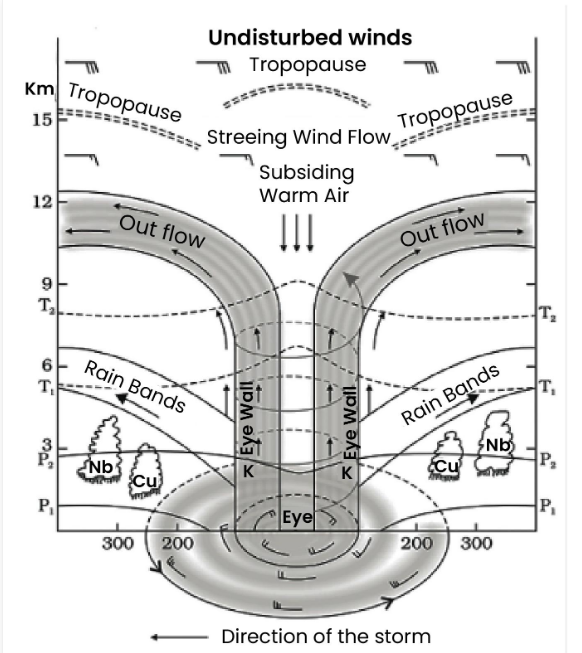
Key characteristics
- Low-pressure centre: Atmospheric pressure is lower at the centre than in the surrounding region.
- Converging winds: Surface winds move towards the low-pressure centre.
- Rotation: The Coriolis force causes the system to rotate.
- Warm core: Tropical cyclones generally have a warm-core structure.
- Latent heat: Heat released during the condensation of water vapour provides energy for storm intensification.
- No fronts: Unlike typical temperate cyclones, tropical cyclones generally do not have warm and cold fronts.
Favourable Conditions:
Tropical cyclones do not develop over every warm ocean. Several atmospheric and oceanic conditions must occur together.
- Warm Sea-Surface Temperature- Sea-surface temperatures of approximately 26.5°C or higher are generally favourable.
- Sufficient Coriolis Force - It is very weak at the Equator, Tropical cyclones therefore rarely form within approximately 5° latitude of the Equator.
- Tropical cyclones rotate anticlockwise in the Northern Hemisphere and clockwise in the Southern Hemisphere.
- Low vertical wind shear favours cyclone formation.
- Moist air in the middle troposphere supports persistent thunderstorms.
- The atmosphere must support the upward movement of warm, moist air.
- Rising air cools, water vapour condenses and thunderstorms develop. Repeated condensation releases latent heat, helping maintain the storm.
- Pre-existing Low-Pressure Disturbance
Formation of Tropical Cyclones
- Tropical cyclone formation is called Tropical Cyclogenesis. It involves the gradual development of an organised low-pressure system over warm ocean water.
- Step 1: Heating of ocean water
- Step 2: Formation of a low-pressure area
- Step 3: Condensation and latent heat release
- Step 4: Pressure falls further
- Step 5: Rotation develops
- Step 6: Intensification- If the ocean remains warm and atmospheric conditions remain favourable, the system may strengthen into a tropical depression and then a named tropical storm or regional equivalent.
- Step 7: Mature cyclone- A well-developed cyclone may develop an eye, an eyewall and spiral rainbands.
Why Do Cyclones Form Mostly on Western Margins of Oceans?
Tropical cyclones tend to develop more frequently over the western parts of tropical ocean basins because these regions often have favourable combinations of warm water, moisture and atmospheric circulation.
A. Warm ocean currents and deep warm water
B. Role of trade winds- Easterly trade winds generally push surface waters westward in tropical oceans.
C. Cold currents on eastern ocean margins- Eastern margins of some tropical oceans are influenced by cold currents and coastal upwelling.
D. Atmospheric conditions
- Suitable atmospheric humidity, low vertical wind shear and a pre-existing disturbance are also necessary.
Structure of a Tropical Cyclone
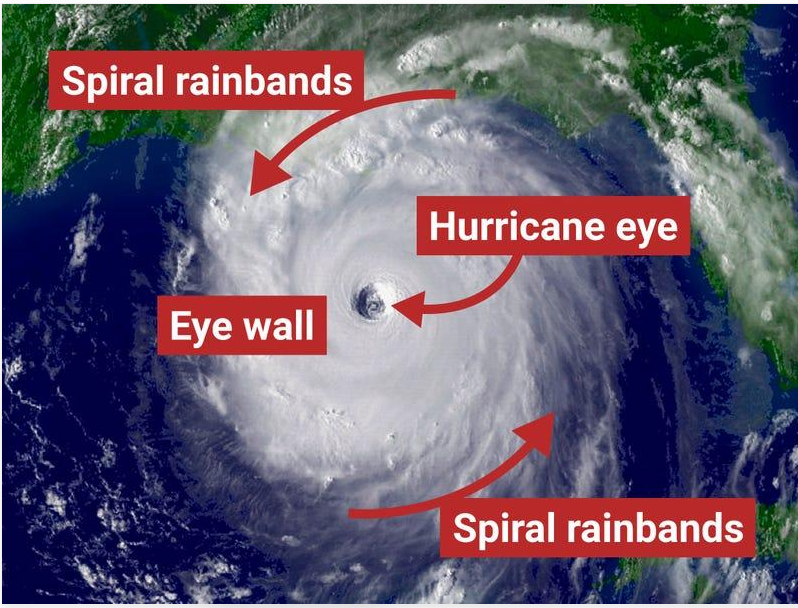
A. Eye- The eye is the central region of a sufficiently developed tropical cyclone.
Characteristics:
- Relatively calm winds compared with the eyewall.
- Often partly clear skies.
- Air commonly descends within the eye.
- Lowest atmospheric pressure is generally found near the centre.
B. Eyewall- It is the ring of intense thunderstorms surrounding the eye.
Characteristics:
- Usually contains the strongest sustained winds.
- Produces intense rainfall.
- Has strong upward air movement.
- Plays a major role in the cyclone's intensity.
C. Spiral Rainbands-These are curved bands of clouds and thunderstorms extending outward from the central region.
They produce:
- Heavy rainfall.
- Thunderstorms and gusty winds.
- Localised flooding and, occasionally, tornadoes in some regions.
D. The cyclone's central pressure is lower than the pressure of the surrounding environment.
E. Upper-Level Outflow- Air rises through thunderstorms and spreads outward near the upper troposphere.
Regional Names of Tropical Cyclones
The same general type of tropical weather system has different names in different ocean basins.
| Region | Common name | Example |
|---|---|---|
| North Atlantic Ocean | Hurricane | Hurricane Katrina |
| Eastern North Pacific | Hurricane | Hurricane Patricia |
| Western North Pacific | Typhoon | Typhoon Haiyan |
| Bay of Bengal and Arabian Sea | Cyclone | Cyclone Amphan |
| South Indian Ocean | Tropical cyclone | Cyclones affecting Madagascar |
| South Pacific Ocean | Tropical cyclone | Cyclones affecting Fiji |
UPSC Prelims Practice Questions
Q. Consider the following statements about tropical cyclone formation:
- Tropical cyclones generally require warm ocean water.
- Low vertical wind shear favours tropical cyclone development.
- Tropical cyclones frequently originate at the Equator because the Coriolis force is strongest there.
Which statements are correct?
(A) 1 only
(B) 1 and 2 only
(C) 2 and 3 only
(D) 1, 2 and 3
UPSC Mains Practice Question
Q. Explain the conditions necessary for the formation of tropical cyclones. Why is the Bay of Bengal particularly vulnerable to their destructive impacts? Discuss measures to reduce cyclone-related losses. (250 words)
The Siang Dam Project (SUMP)
UPSC RELEVANCE: GS Paper II: India–China Relations | GS Paper III: Infrastructure and Environment | GS Paper I: Himalayan Rivers | PRELIMS
Why in the News?
A proposed 11,200 MW Siang Upper Multipurpose Project (SUMP) in Arunachal Pradesh has triggered protests over displacement, environmental risks and the loss of ancestral land. The state government considers the project strategically important amid China's upstream hydropower development on the Yarlung Tsangpo River.
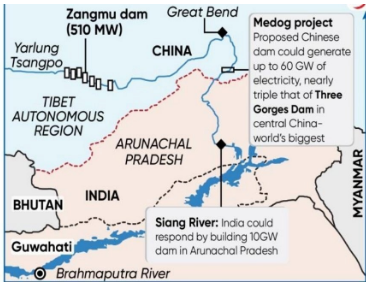
What is the Siang Dam Project?
- Full name: Siang Upper Multipurpose Project (SUMP).
- Location: Siang River valley, Arunachal Pradesh, in Northeast India.
- Proposed capacity: Approximately 11,200 MW.
- Implementing agency: National Hydroelectric Power Corporation (NHPC), according to the news report.
- Nature: A proposed multipurpose hydropower and water-storage project.
- Current status: Feasibility assessment is under consideration; the state government says a final decision to construct the dam has not been taken.
Background
- Initial Proposal: Conceived in 2008 to harness Siang’s hydropower potential through two projects: Stage-I (6,000 MW) and Stage-II (3,750 MW).
- Project Consolidation: Subsequently restructured into a single 11,200-MW multipurpose hydropower project, proposed for development by the National Hydroelectric Power Corporation (NHPC).
- Chinese Dam Concerns: Gained urgency following China’s 2025 Medog hydropower project on the Yarlung Tsangpo, intensifying India’s concerns over upstream water regulation.
Key Features
- Hydropower Generation- Proposed installed capacity of approximately 11,200 MW.
- Water Storage- The proposed project envisages substantial reservoir storage, provide approximately 9.2 billion cubic metres of live storage, regulate river flows, subject to technical feasibility and operating arrangements. Hindustan Times
- Flood Moderation
- Strategic Location- The project is proposed on a river that flows from Tibet into India.
Significance
Strengthens India’s downstream water-storage and flow-regulation capabilities amid China’s upstream hydropower expansion, enhancing Brahmaputra basin resilience.
Highlights the need to reconcile strategic infrastructure, ecological protection and indigenous land rights through transparent consultation and sustainable development.
UPSC Prelims Practice Questions
Q. With reference to the Siang Upper Multipurpose Project (SUMP), consider the following statements:
- It is proposed in Arunachal Pradesh.
- It is associated with the Siang River, which is the Indian stretch of the Yarlung Tsangpo.
- Its proposed installed capacity is approximately 11,200 MW.
Which of the statements given above are correct?
(A) 1 only
(B) 1 and 2 only
(C) 2 and 3 only
(D) 1, 2 and 3
Special Executive Magistrate
UPSC relevance: GS Paper II: Polity and Governance | PRELIMS
Why in the News?
Special Executive Magistrates (SEMs) came into focus after the detention of two CJP leaders during Delhi protests.
Who is a Special Executive Magistrate?
A Special Executive Magistrate (SEM) is an officer appointed by the State Government or an authorised authority, under the applicable criminal procedure law, to exercise specified executive-magisterial powers for maintaining public order and preventing breaches of peace.
The role is generally related to preventive action and public-order administration, rather than conducting a regular criminal trial.
Legal Provision
Under Section 15 of the Bharatiya Nagarik Suraksha Sanhita (BNSS), 2023, the State Government may appoint Special Executive Magistrates for specified areas or functions. It may appoint existing Executive Magistrates or police officers not below the rank of Superintendent of Police (SP), or equivalent, and confer specified Executive Magistrate powers on them.
Main Functions
Depending on the powers specifically conferred, a Special Executive Magistrate may be involved in:
- Maintaining public order in a designated area.
- Preventing breaches of peace.
- Performing specified executive-magisterial duties during sensitive events or situations.
Important: A Special Executive Magistrate does not automatically possess every power of an Executive Magistrate. The powers depend on the government order and applicable law.
Difference between Executive Magistrate & Special Executive Magistrate
| Basis | Executive Magistrate | Special Executive Magistrate (SEM) |
|---|---|---|
| Legal provision | Section 14, BNSS, 2023 | Section 15, BNSS, 2023 |
| Appointment | Appointed by the State Government | Appointed by the State Government for specified areas or purposes |
| Powers | Powers conferred under the law | Powers specifically conferred by the government’s appointment order |
| Examples | District Magistrate (DM), Additional District Magistrate (ADM), Sub-Divisional Magistrate (SDM) | An officer appointed as an SEM for specified functions |
Executive Magistrate vs Judicial Magistrate
| Basis | Executive Magistrate | Judicial Magistrate |
|---|---|---|
| Main role | Executive administration and preventive public-order functions | Judicial proceedings and criminal cases within jurisdiction |
| Appointment framework | State Government | High Court's control under the applicable legal framework |
| Relevant BNSS provisions | Sections 14–17 | Sections 9–13 |
| Example | District Magistrate (DM), Sub-Divisional Magistrate (SDM) | Judicial Magistrate First Class |
UPSC Practice Question
Q. Under Section 15 of the BNSS, 2023, who may be appointed as a Special Executive Magistrate?
- (A) Any police constable
- (B) Any police officer of Inspector rank or above
- (C) An Executive Magistrate or a police officer not below the rank of SP or equivalent
- (D) Only a sitting High Court judge
Government Notifies E100 as Auto Fuel
UPSC RELEVANCE: PRELIMS | GS Paper III – Environment, Energy and Economy
Why in the News?
On 26 October 2026, the Ministry of Road Transport and Highways (MoRTH) notified amendments to the Central Motor Vehicles Rules, 1989, formally including E100 ethanol fuel alongside E85 in emission-related provisions for eligible flex-fuel vehicles.

What is E100 Fuel?
- E100: Fuel consisting predominantly of ethanol, commonly described as 100% ethanol.
- E85: Fuel containing up to 85% ethanol by volume.
- E20: Petrol blended with 20% ethanol and 80% petrol.
- Flex-Fuel Vehicle (FFV): A vehicle specially designed and certified to operate on different petrol–ethanol blends.
Key Features
| Ministry: Ministry of Road Transport and Highways (MoRTH). |
|---|
| Legal framework: Central Motor Vehicles Rules, 1989. |
| Purpose: To facilitate the development and certification of vehicles using high-ethanol fuels. |
| Important condition: E85 and E100 can be used only in vehicles specifically designed and certified for these fuels. |
| Existing vehicles: Ordinary petrol vehicles, including E20-compatible vehicles, must not use E100 unless specifically designed and certified for it. The notification does not require existing vehicle owners to modify their vehicles. |
Why Is E100 Important for India?
| Benefit | Significance |
|---|---|
| Energy security | May reduce dependence on imported crude oil. |
| Environment | Can reduce certain pollutants and lifecycle greenhouse gas emissions, depending on production methods. |
| Agriculture | Can create demand for domestically produced ethanol and agricultural feedstocks. |
| Economy | May support domestic biofuel production and related industries. |
| Alternative fuels | Encourages automobile manufacturers to develop flex-fuel vehicles |
.
These benefits depend on ethanol feedstocks, production processes, vehicle technology and fuel availability.
Challenges
- Limited availability of E100-compatible vehicles and refuelling infrastructure.
- Ethanol production requires agricultural feedstocks, land and water.
- Ethanol has lower energy content per litre than petrol.
- Vehicle components must be compatible with high ethanol concentrations.
UPSC Prelims Question
Q. With reference to E100 fuel, consider the following statements:
- E100 consists predominantly of ethanol.
- All vehicles compatible with E20 petrol can automatically use E100.
- Flex-fuel vehicles can be designed to operate on different ethanol–petrol blends.
Which of the statements given above are correct?
(A) 1 and 2 only
(B) 1 and 3 only
(C) 2 and 3 only
(D) 1, 2 and 3