
Sunday
8 November 2026
1 article on this date
What the BRICS Carbon Market Partnership Needs
Context
- The BRICS Carbon Markets Partnership has gained importance discussions on strengthening cooperation among BRICS countries in carbon markets. The central issue is that BRICS countries have different carbon trading systems, emission measurement methods and verification standards. Hence, BRICS should first develop common rules for measuring and verifying carbon emissions before attempting to establish a common carbon trading platform.
What Is a Carbon Market?
- A carbon market is a mechanism through which emission reductions are converted into tradable units called carbon credits.
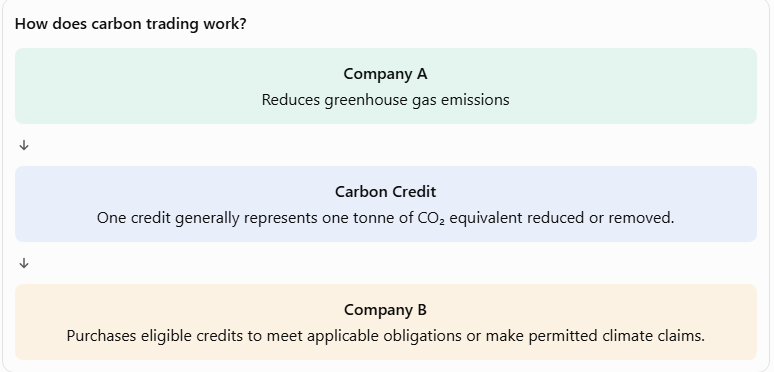
Example: A renewable energy project reduces emissions by replacing electricity generated from coal. Eligible and verified emission reductions may generate carbon credits.
Types of Carbon Markets
| Compliance Carbon Market | Voluntary Carbon Market |
|---|---|
| Created under government regulations | Participation is voluntary |
| Companies have legally prescribed emission obligations | Companies purchase credits voluntarily |
| Compliance is monitored by regulators | Operates through voluntary standards and registries |
| Example: India's CCTS | Voluntary carbon offset projects |
Remember: Carbon credit trading is not the same as simply paying for pollution. It requires credible measurement and verification of emission reductions.
Why Does BRICS Need a Carbon Market Partnership?
- BRICS countries are important players in global energy consumption, industrial production and greenhouse gas emissions. However, their carbon markets operate differently.
Different approaches followed by major BRICS economies
| Country | Carbon market approach |
|---|---|
| China | Emissions-intensity-based benchmarks |
| India | Emissions-intensity-based targets under CCTS |
| Brazil | Developing an emissions cap-based regulated market |
Major problems
- Different standards: Countries use different methods to calculate emission reductions.
- Different regulations: Carbon credits may have different legal status.
- Verification issues: Different countries may follow different verification procedures.
- Registry incompatibility: Carbon credit databases may not communicate with each other.
- Double counting: The same emission reduction may be claimed by two different countries.
Core problem: A carbon credit generated in one BRICS country may not automatically be recognised in another country because their accounting and verification rules differ.
Why Is a Common Carbon Market Important?
A. Trade competitiveness – EU's CBAM
- The European Union introduced the Carbon Border Adjustment Mechanism (CBAM).
What is CBAM?
- It imposes a carbon-related cost on certain imported carbon-intensive products to address carbon leakage.
Products covered include:
- Iron and steel
- Aluminium
- Cement
- Fertilisers
- Electricity
- Hydrogen
Impact on BRICS countries:
- Exporters need reliable emissions data.
- Poor carbon accounting can increase compliance difficulties.
- A common BRICS measurement framework could help exporters demonstrate the carbon intensity of their products.
B. Climate finance
- Mobilises investment in renewable energy.
- Encourages low-carbon technologies.
- Creates incentives for emission reduction projects.
- Can support developing countries in their climate transition.
C. Collective bargaining
A common framework could strengthen BRICS' negotiating position in international climate discussions.
What Does the BRICS Partnership Actually Need?
Article 6 of the Paris Agreement
Article 6 provides the framework for international cooperation in reducing greenhouse gas emissions.
| Provision | Key feature |
|---|---|
| Article 6.2 | Cooperative approaches and transfer of Internationally Transferred Mitigation Outcomes (ITMOs) |
| Article 6.4 | UN-supervised carbon crediting mechanism |
| Article 6.8 | Non-market approaches to climate cooperation |
Role of New Development Bank (NDB)
New Development Bank (NDB) can support the partnership through:
- Financing low-carbon infrastructure.
- Supporting carbon market infrastructure.
- Providing technical assistance.
- Supporting pilot carbon exchange projects.
- Mobilising climate finance for developing economies.
Significance for India
| Area | Benefits for India |
|---|---|
| International trade | Better preparation for CBAM-related requirements |
| Carbon market | Strengthening of India's Carbon Credit Trading Scheme |
| Climate finance | Greater investment in clean energy |
| Industry | Incentives for low-carbon manufacturing |
| Diplomacy | Greater role in shaping international carbon market rules |
| Energy transition | Support for India's climate commitments |
India's Carbon Credit Trading Scheme (CCTS)
- Introduced under the Energy Conservation Act framework.
- Nodal ministry: Ministry of Power.
- Bureau of Energy Efficiency (BEE) plays a key implementation role.
- Provides a framework for India's domestic carbon credit trading mechanism.
Challenges Before BRICS
| Challenge | Explanation |
|---|---|
| Different national interests | Countries have different development and climate priorities. |
| Regulatory differences | Carbon market rules are not uniform. |
| Carbon credit quality | Risk of low-quality or non-additional credits. |
| Double counting | Inconsistent accounting can lead to duplicate claims. |
| Geopolitical tensions | Political and financial restrictions may complicate cooperation. |
| Competition | BRICS economies also compete in global industrial markets. |
Way Forward
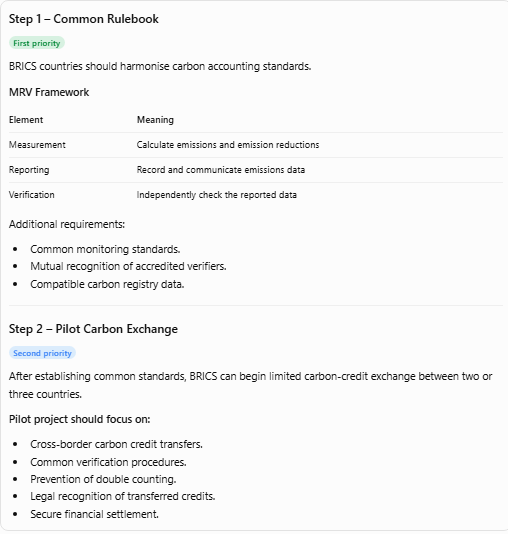
- Develop common MRV standards.
- Ensure transparent and credible carbon accounting.
- Make national carbon registries interoperable.
- Start with small-scale pilot carbon exchanges.
- Follow Article 6 of the Paris Agreement.
- Strengthen NDB's role in climate finance.
- Ensure that carbon trading contributes to actual emission reductions rather than merely allowing offsetting.