
3 November 2026
7 topics in this edition
03 Nov 2026 News
How AI Training Models Could Compromise Privacy
UPSC GS Paper III – Science & Technology
Context
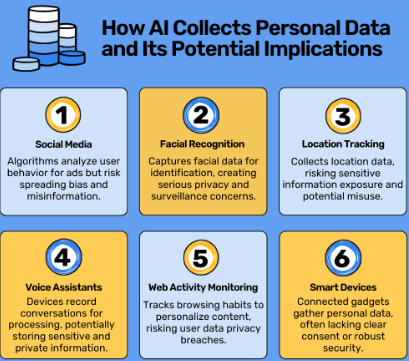
A gap between the rapid development of Artificial Intelligence and the legal safeguards available to protect personal data. AI models require large datasets for training. These datasets may contain sensitive and identifiable information. Even when data is anonymised, AI models may sometimes reveal personal details through carefully designed queries. This raised concerns over an individual's personal privacy.

How AI Training Models Can Compromise Privacy
| Mechanism | Explanation |
|---|---|
| Data scraping | AI developers collect large amounts of information from websites and digital platforms, sometimes without meaningful consent. |
| Data memorisation | Models may memorise personal information contained in training datasets. |
| Re-identification | Anonymised information may be combined with other data to identify individuals. |
| Data leakage | AI outputs may unintentionally reveal sensitive information learned during training. |
| Profiling | Personal data can be used to infer an individual's behaviour, preferences and characteristics. |
Important concept – Re-identification: Identifying a person from data that was previously anonymised by combining it with other available information.
Legal Framework in India
A. Constitutional Provisions- Article 21 – Right to Life and Personal Liberty
- Includes the Right to Privacy as a Fundamental Right.
- Privacy was recognised as a fundamental right by the Supreme Court in the landmark K.S. Puttaswamy v. Union of India (2017) judgment.
- Includes informational privacy and protection of personal data.
B. Information Technology Act, 2000
The IT Act and the Information Technology (Reasonable Security Practices and Procedures and Sensitive Personal Data or Information) Rules, 2011 provided an earlier framework for protecting sensitive personal information.
The 2011 Rules covered categories such as:
- Financial information
- Medical and health information
- Sexual orientation
- Biometric information
C. Digital Personal Data Protection Act, 2023
| Feature | Details |
|---|---|
| Act | Digital Personal Data Protection Act, 2023 |
| Rules | DPDP Rules, 2025 |
| Main objective | Protection of digital personal data |
| Data Fiduciary | Entity determining the purpose and means of processing personal data |
| Data Principal | Individual to whom personal data relates |
| Data Protection Board | Adjudicates specified violations under the Act |
Major Challenges
- Consent gap: Individuals may not know that their personal data is being used to train AI models.
- Anonymisation limitations: Combining different datasets can make re-identification possible.
- Lack of transparency: Users may not know what data an AI model has used.
- Difficulty in deletion: Removing personal information after a model has been trained is technically challenging.
- Cross-border data flows: Data may be transferred and processed across different jurisdictions.
- Innovation versus regulation: Excessive restrictions may affect AI research, innovation and economic growth.
Way Forward
| Measure | Expected benefit |
|---|---|
| Data minimisation | Collect only necessary personal information. |
| Informed consent | Ensure meaningful user knowledge and control. |
| Purpose limitation | Restrict data use to specified purposes. |
| Privacy by design | Incorporate privacy safeguards during AI development. |
| Differential privacy | Reduce the risk of identifying individuals from datasets. |
| Federated learning | Train models without necessarily centralising raw personal data. |
| Regular AI audits | Identify privacy vulnerabilities and data leakage. |
| Stronger accountability | Make AI developers responsible for unlawful data use. |
Recent Indian Initiative: DEPA for AI Training
The Ministry of Electronics and Information Technology (MeitY) launched the Handbook on Data Empowerment and Protection Architecture (DEPA) for AI Training on 31 October 2026.

Key points:
- Enables secure data sharing for AI training.
- Seeks to protect privacy, intellectual property and institutional control.
- Uses controlled computing environments and contractual permissions.
- Emphasises data provenance and accountability.
- Follows the principle: “Model travels to the data, rather than the data travelling to the model.”
Mains Practice Question
Q: Artificial Intelligence offers enormous opportunities for economic and social development, but its training processes can create serious threats to informational privacy. Discuss the challenges and suggest measures to ensure responsible AI development in India.
UPSC Prelims Practice MCQ
Q. With reference to the Right to Privacy in India, consider the following statements:
- The Supreme Court recognised the Right to Privacy as a Fundamental Right in 2017.
- The right to privacy is associated with Article 21.
- Informational privacy is outside the scope of the Right to Privacy.
Which of the statements is/are correct?
- A. 1 only
- B. 1 and 2 only
- C. 2 and 3 only
- D. 1, 2 and 3
SC Permits Green Crackers for Two Days in Delhi-NCR
GS Paper III – Environment | GS Paper II – Governance & Judiciary
Why in News?
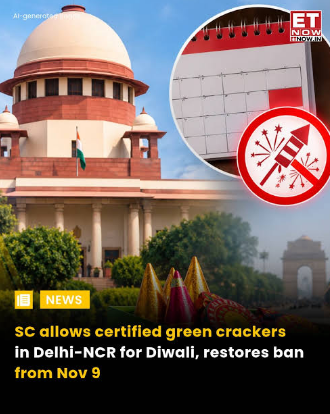
On 29 October 2026, the Supreme Court passed an interim order permitting the use of certified green firecrackers in Delhi-NCR for two days, 7 and 8 November 2026, subject to strict conditions. The Court restored the complete ban on firecrackers from 9 November 2026.
Supreme Court's Directions
| Parameter | Directions |
|---|---|
| Certification | CSIR-NEERI-approved green crackers and PESO compliance |
| QR code | Product-specific QR code on packaging |
| Barium nitrate | Restricted formulations; only approved formulations permitted |
| Joined crackers (Ladis) | Prohibited |
| Online sale | Prohibited |
| No-cracker zones | Within 300 metres of specified sensitive institutions |
What are Green Crackers?
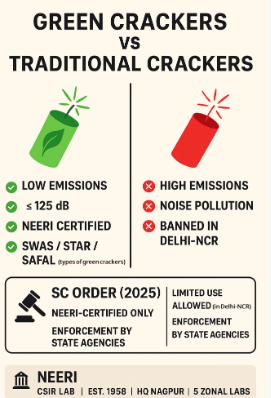
Green crackers are fireworks developed to reduce emissions of harmful pollutants compared with conventional firecrackers.
| Feature | Explanation |
|---|---|
| Developer/research institution | CSIR-NEERI |
| Safety regulator | Petroleum and Explosives Safety Organisation (PESO) |
| Objective | Reduce emissions and environmental impact |
| Identification | Approved products carry QR codes |
| Limitation | They are not pollution-free |
Important distinction: Green crackers may reduce emissions, but they still generate particulate matter, gases, noise and solid waste.
Why Is Delhi-NCR Vulnerable to Air Pollution?
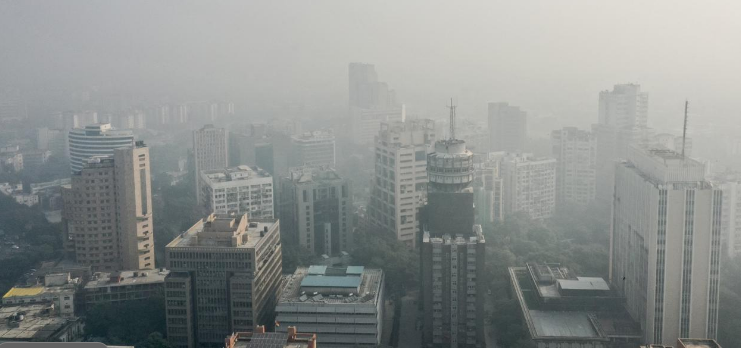
Delhi-NCR experiences a combination of local emissions and unfavourable meteorological conditions, particularly during winter.
| Factor | Contribution to pollution |
|---|---|
| Vehicular emissions | Release of particulate matter and nitrogen oxides |
| Industrial emissions | Release of gases and particulate pollutants |
| Construction dust | Major source of PM10 |
| Stubble burning | Adds smoke and particulate matter during the post-monsoon period |
| Firecrackers | Cause short-duration increases in particulate matter and other pollutants |
| Temperature inversion | Restricts vertical dispersion of pollutants |
| Low wind speed | Slows the dispersal of pollutants |
Constitutional and Legal Framework
| Provision | Significance |
|---|---|
| Article 21 | Right to life includes the right to a clean and healthy environment. |
| Article 48A | Directs the State to protect and improve the environment. |
| Article 51A(g) | Fundamental duty of citizens to protect the natural environment. |
| Article 25 | Freedom of religion subject to public order, morality and health. |
| Environment (Protection) Act, 1986 | Umbrella legislation for environmental protection. |
| Air Act, 1981 | Prevention, control and abatement of air pollution. |
| Noise Pollution Rules, 2000 | Regulation of noise levels and restrictions on loudspeakers and firecrackers. |
Important Supreme Court Judgments
- Arjun Gopal v. Union of India (2018): Directions on regulation of firecrackers and promotion of less-polluting alternatives.
- M.C. Mehta v. Union of India: Important environmental litigation relating to air pollution in Delhi.
- Vellore Citizens Welfare Forum v. Union of India (1996): Recognition of the Precautionary Principle and Polluter Pays Principle in Indian environmental jurisprudence.
Government Schemes and Programmes
| Scheme / Programme | Ministry / Institution | Key objective |
|---|---|---|
| National Clean Air Programme (NCAP), 2019 | MoEFCC | Improve air quality through city-specific action plans. |
| Graded Response Action Plan (GRAP) | CAQM | Emergency measures according to pollution severity in Delhi-NCR. |
| National Air Quality Monitoring Programme (NAMP) | CPCB | Monitor ambient air quality across India. |
| Mission LiFE, 2022 | MoEFCC | Promote environmentally responsible lifestyles. |
| Swachh Bharat Mission–Urban 2.0 | Ministry of Housing and Urban Affairs | Scientific waste management and garbage-free cities. |
| PM E-DRIVE Scheme | Ministry of Heavy Industries | Promote electric mobility and reduce vehicular emissions. |
| Green India Mission | MoEFCC | Enhance forest and tree cover and ecosystem services. |
| National Green Hydrogen Mission | Ministry of New and Renewable Energy | Promote green hydrogen and industrial decarbonisation. |
Major Challenges
- Weak enforcement: Illegal conventional crackers may be sold in the name of green crackers.
- Regional coordination: Pollution crosses administrative boundaries and requires cooperation among NCR States.
- Scientific limitations: Green crackers reduce emissions but do not eliminate pollution.
- Multiple pollution sources: Firecrackers are only one contributor to Delhi-NCR's air pollution.
- Monitoring gaps: AQI data and pollution levels need reliable, continuous monitoring.
- Public participation: Restrictions cannot succeed without awareness and cooperation.
Way Forward
- Strengthen the enforcement of certified green-cracker standards.
- Use QR-code-based verification to prevent counterfeit products.
- Improve coordination among Delhi, Haryana, Uttar Pradesh and Rajasthan.
- Improve coordination among Delhi, Haryana, Uttar Pradesh and Rajasthan.
- Strengthen public transport and control vehicular emissions.
- Control construction dust and industrial pollution.
- Promote waste management and prevent open burning.
- Encourage low-pollution festival celebrations.
- Undertake scientific assessment of pre-Diwali, Diwali and post-Diwali air quality.
UPSC Mains Question
Q. Examine how the judiciary can balance cultural practices with environmental protection and the Right to Health. (150 marks)
UPSC Prelims Question
Q. Which of the following are components of environmental governance?
- Precautionary Principle
- Polluter Pays Principle
- Intergenerational Equity
- Sustainable Development
- A. 1 and 2 only
- B. 1, 2 and 3 only
- C. 2, 3 and 4 only
- D. All four
Defence Ministry Signs ₹53,866.50 Crore Contracts for Eight Next-Generation Corvettes
GS Paper III: Internal Security | GS Paper II: Government policies and interventions
Context
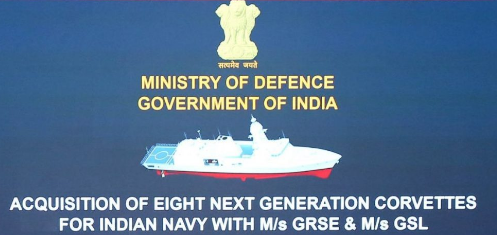
On 2 November 2026, the Ministry of Defence signed contracts worth ₹53,866.50 crore with two Indian defence public sector shipyards for the construction of eight Next-Generation Corvettes (NGCs) for the Indian Navy. The project aims to strengthen India's maritime security, indigenous warship-design capabilities and domestic defence manufacturing ecosystem.
Key Features of the Deal
| Particular | Details |
|---|---|
| Total value | ₹53,866.50 crore |
| Number of warships | 8 Next-Generation Corvettes |
| Ministry | Ministry of Defence |
| GRSE allocation | 5 corvettes |
| GSL allocation | 3 corvettes |
| Design | Indigenous design by Indian Navy |
Participating shipyards:
- Garden Reach Shipbuilders & Engineers (GRSE): Headquartered in Kolkata; will construct five corvettes.
- Goa Shipyard Limited (GSL): Located in Goa; will construct three corvettes.
What is a Corvette?
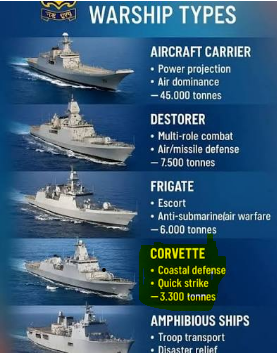
A corvette is a relatively small, fast and versatile naval warship, generally used for coastal defence and operations in nearby maritime regions.
Its major roles include:
- Anti-submarine warfare (ASW).
- Anti-surface warfare.
- Coastal and littoral defence.
- Maritime surveillance and reconnaissance.
- Protection of maritime trade routes.
- Search-and-attack missions.
Important: Corvettes are generally smaller than frigates and destroyers, but modern corvettes can carry advanced missiles, sensors, sonar and combat systems.
Operational Capabilities of Next-Generation Corvettes
According to the Ministry of Defence, the new corvettes will have advanced missiles, weapons and sensor suites, enabling operations across three domains:
- Air domain: Detection and response to aerial threats through advanced sensors and weapon systems.
- Surface domain: Anti-surface warfare and protection against hostile naval vessels.
- Sub-surface domai: Anti-submarine warfare and detection of underwater threats.
The Navy will use these capabilities for coastal defence, littoral operations, maritime surveillance and protection of sea trade routes.
Significance for India's Maritime Security
A. Protection of the Indian Ocean Region (IOR)
- India has a strategic location in the Indian Ocean.
- Important international maritime trade routes pass through the region.
- The corvettes will strengthen India's ability to monitor maritime activity and protect shipping routes.
- They will contribute to coastal and littoral security.
B. Anti-Submarine Warfare Capability
- Increasing submarine activity in the Indian Ocean makes underwater surveillance important.
- Modern sonar and anti-submarine systems help detect and respond to underwater threats.
- The new ships will strengthen the Navy's anti-submarine warfare capabilities.
C. Maritime Domain Awareness (MDA)
- Better surveillance of maritime movements.
- Improved detection of suspicious vessels.
- Support for coordinated naval operations.
- Protection against maritime threats and illegal activities.
D. Strengthening Coastal Defence
- Provides additional naval platforms for coastal operations.
- Enhances India's ability to respond to maritime threats.
- Supports the protection of ports, coastal infrastructure and maritime trade.
Significance for Aatmanirbhar Bharat
The project is particularly significant because it is the first project in which the ships will be designed indigenously by the Indian Navy and constructed by defence public sector shipyards selected through a competitive process.
Employment generation: The Ministry estimates approximately:
- 72 lakh person-days of employment in shipyards.
- 460 lakh person-days in ancillary industries and MSMEs.
- Employment generation over the next 10 years.
Important Defence Schemes and Initiatives
| Scheme / Initiative | Key objective | Relevance to the project |
|---|---|---|
| Aatmanirbhar Bharat | Self-reliance in defence manufacturing | Indigenous warship construction |
| Make in India | Promote domestic manufacturing | Indian shipyards and suppliers |
| Defence Acquisition Procedure (DAP), 2020 | Promote indigenous procurement and defence manufacturing | Domestic procurement framework |
| Positive Indigenisation Lists | Encourage domestic production of defence items | Reduce import dependence |
| Innovations for Defence Excellence (iDEX) | Promote defence innovation and start-ups | Indigenous defence technologies |
| SRIJAN Portal | Promote indigenisation through identification of imported items | Domestic defence suppliers |
| Defence Industrial Corridors | Develop defence manufacturing clusters | Strengthen industrial ecosystem |
India has two Defence Industrial Corridors:
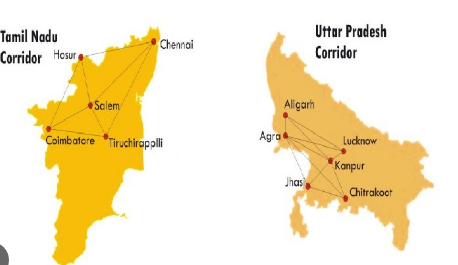
1. Uttar Pradesh Defence Industrial Corridor
- Nodes: Lucknow, Kanpur, Agra, Aligarh, Jhansi and Chitrakoot.
2. Tamil Nadu Defence Industrial Corridor
- Nodes: Chennai, Coimbatore, Hosur, Salem and Tiruchirappalli.
These corridors aim to strengthen India's defence manufacturing ecosystem.
Comparison: Corvette vs Frigate vs Destroyer
| Feature | Corvette | Frigate | Destroyer |
|---|---|---|---|
| Relative size | Smaller | Medium | Larger |
| Main role | Coastal defence and littoral warfare | Escort and multi-role operations | Fleet defence and high-intensity warfare |
| Operational range | Generally shorter | Longer | Generally longer |
| Capabilities | Surface and anti-submarine warfare | Multi-role | Advanced air, surface and anti-submarine warfare |
Challenges for India's Indigenous Shipbuilding
- Technology dependence: Some advanced propulsion, sensors and combat systems may still involve foreign technologies.
- Cost escalation: Large warship projects can face increases in costs during development and construction.
- Delivery delays: Complex design and integration processes may delay induction.
- Supply-chain constraints: Dependence on specialised components can affect production.
- Research and development: Greater investment is needed in indigenous propulsion, sonar, radar and weapons systems.
- Private-sector participation: More collaboration with private shipyards and MSMEs is needed.
Way Forward
- Increase indigenous production of naval propulsion and combat systems.
- Strengthen defence R&D through DRDO, industry and academic institutions.
- Improve technology transfer and domestic component manufacturing.
- Encourage private shipyards and MSMEs to participate in naval supply chains.
- Ensure timely delivery and quality control.
- Strengthen maritime cooperation with Indian Ocean littoral countries.
UPSC Prelims Practice MCQ
Q. With reference to the Next-Generation Corvette project, consider the following statements:
- The project involves construction of eight corvettes.
- GRSE will construct five corvettes.
- Goa Shipyard Limited will construct three corvettes.
- The ships are designed indigenously by the Indian Navy.
Which of the statements given above are correct?
- A. 1 and 2 only
- B. 1, 2 and 3 only
- C. 2, 3 and 4 only
- D. 1, 2, 3 and 4
Mains Practice Question
Q. India's maritime security requirements are increasing with the growing strategic importance of the Indian Ocean Region. Examine.
Prelims Pointer
VAYU Framework
GS Paper III – Internal Security and Defence
Context
On 1 November 2026, Air Chief Marshal Ashutosh Dixit assumed charge as the 29th Chief of the Air Staff and outlined the Indian Air Force's strategic vision under the VAYU framework.
What is the VAYU Framework?
VAYU is a four-pillar strategic vision for transforming the Indian Air Force into a combat-ready, technologically advanced and self-reliant force.
V A Y U
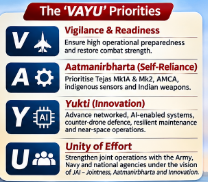
V – Vigilance, Victory and Readiness
- Maintain operational preparedness.
- Restore fighter squadron strength towards the sanctioned level.
- Ensure readiness of aircraft, radars, air-defence units and personnel.
A – Aatmanirbharta (Self-reliance)
- Promote indigenous aircraft, sensors and weapons.
- Prioritise Tejas Mk1, Mk1A, future Tejas variants and AMCA.
- Reduce dependence on foreign defence suppliers.
Y – Yukti (Ingenuity and Innovation)
- Promote innovation in military doctrine and technology.
- Develop AI-enabled command-and-control systems.
- Strengthen counter-drone defence.
- Improve maintenance, force protection and operational resilience.
- Explore near-space as an operational domain.
U – Unity of Effort
- Strengthen coordination among the Army, Navy and Air Force.
- Promote joint planning and integrated military operations.
- Coordinate with national security agencies.
Major Issues Addressed by the Framework
A. Shortage of Fighter Squadrons
- The IAF has a sanctioned strength of 42 fighter squadrons.
- Its actual fighter squadron strength remains below this sanctioned level.
- Phasing out of older aircraft and delays in new aircraft induction have contributed to the gap.
- Restoration of combat strength is a foremost priority under VAYU.
B. Indigenous Defence Production
Important indigenous platforms include:
| Aircraft / Programme | Significance |
|---|---|
| LCA Tejas Mk1 | Indigenous light combat aircraft |
| LCA Tejas Mk1A | Improved version with enhanced avionics and operational capabilities |
| Tejas Mk2 | Medium-weight fighter development programme |
| AMCA | Advanced Medium Combat Aircraft; fifth-generation stealth fighter programme |
C. Emerging Technologies in Warfare
| Technology | Military application |
|---|---|
| Artificial Intelligence | Decision support and command systems |
| Drones | Surveillance, reconnaissance and combat |
| Counter-drone systems | Detection and neutralisation of hostile drones |
| Cyber warfare | Protection and disruption of digital military infrastructure |
| Space technology | Satellite-based communication, navigation and surveillance |
| Electromagnetic spectrum | Electronic warfare and communication disruption |
| Long-range precision weapons | Accurate strikes against distant targets |
Significance of the VAYU Framework
- National security: Strengthens the IAF's operational preparedness.
- Strategic autonomy: Reduces dependence on foreign suppliers.
- Technological advancement: Promotes AI, drones, cyber and space capabilities.
- Military integration: Improves coordination among the three services.
- Defence economy: Encourages domestic industries, MSMEs and start-ups.
- Deterrence: Strengthens India's ability to deter potential adversaries through credible air power.
UPSC Prelims MCQ
Q. With reference to the VAYU framework, consider the following statements:
- It is a strategic vision of the Indian Air Force.
- Yukti focuses on innovation in doctrine, procedures and technology.
- Unity of Effort emphasises coordination among the Army, Navy and Air Force.
- Aatmanirbharta focuses on increasing dependence on imported weapons.
Which of the statements given above are correct?
- A. 1 and 2 only
- B. 1, 2 and 3 only
- C. 2, 3 and 4 only
- D. All four
Ghost Star
Why in News?
Astronomers are reconstructing nearly 12 billion years of the Milky Way's evolutionary history by studying remnants of smaller galaxies absorbed by it. These remnants include streams and groups of stars, sometimes described as ghost stars.
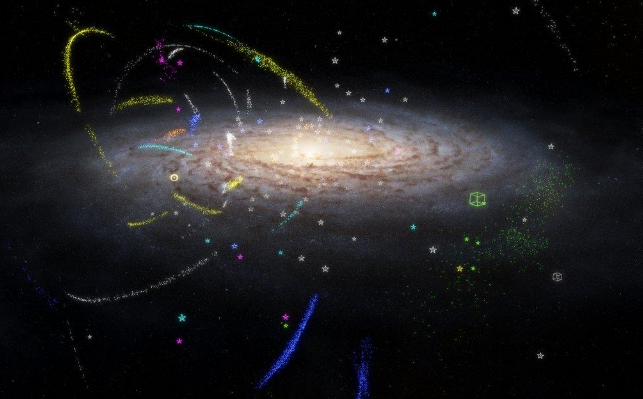
What Are Ghost Stars?
- Ghost stars are not a separate category of stars or supernatural objects.
- The term is used informally for stars that remain as remnants of smaller galaxies disrupted and absorbed by a larger galaxy.
- The gravitational pull of the larger galaxy can tear apart smaller galaxies through tidal forces.
- Their stars may remain distributed in streams, clusters and other structures within the larger galaxy.
- Their chemical composition and orbital movements can preserve clues about their original galaxy.
How Does the Milky Way Absorb Smaller Galaxies?
This process is called galactic cannibalism or galaxy merger.

Process:
- A smaller galaxy approaches a larger galaxy under gravitational attraction.
- The larger galaxy's gravitational field exerts tidal forces on the smaller galaxy.
- The smaller galaxy gets stretched and gradually disrupted.
- Its stars, gas and other matter become part of the larger galaxy.
- Some stars form long streams and clusters, retaining evidence of their original origin.
- This process contributes to the gradual growth and evolution of galaxies.
How Do Astronomers Identify Ghost Stars?
Astronomers use three major characteristics to trace the origin of stars:
| Parameter | What it reveals |
|---|---|
| Age | When the stars were formed |
| Chemical composition | The environment and galaxy in which they originated |
| Motion and orbital pattern | Whether they share a common origin or came from an external galaxy |
For example, stars originating in smaller galaxies may have different elemental abundances and orbital patterns from stars formed within the Milky Way.
Important Space Missions and Surveys
- Gaia Mission
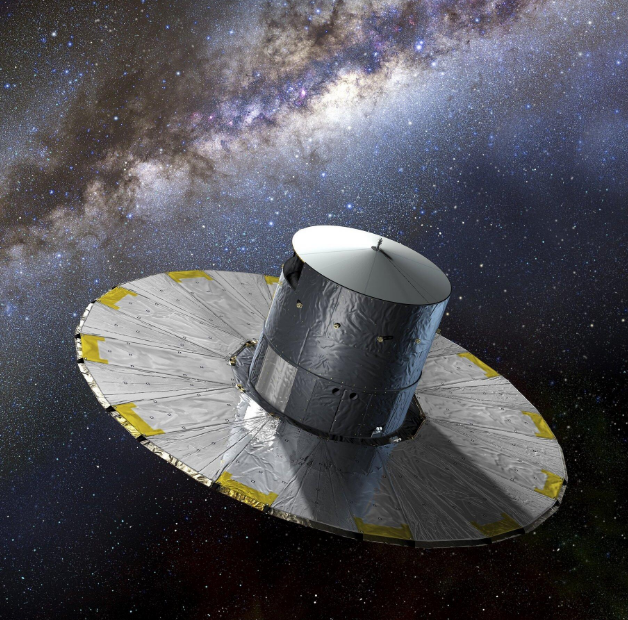
Agency: European Space Agency (ESA).
- Launched: 19 December 2013.
- Objective: Create a highly accurate three-dimensional map of the Milky Way.
- Measures stellar positions, distances, motions and other properties.
- Helps identify stars originating from ancient galactic mergers.
- APOGEE
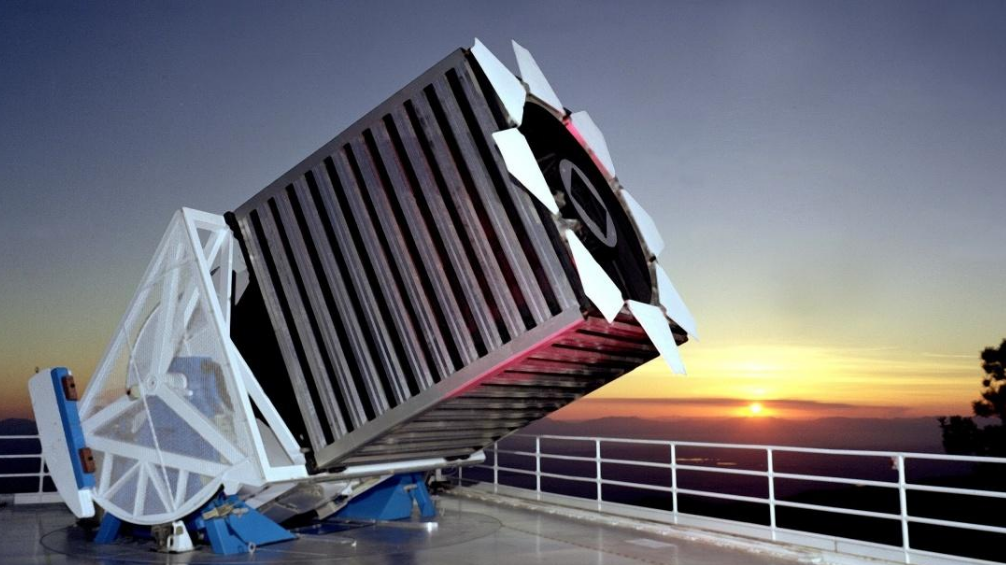
- Full form: Apache Point Observatory Galactic Evolutionary Experiment.
- Uses stellar spectroscopy to study chemical compositions.
- Helps determine the chemical history and origin of stars.
- Euclid Mission
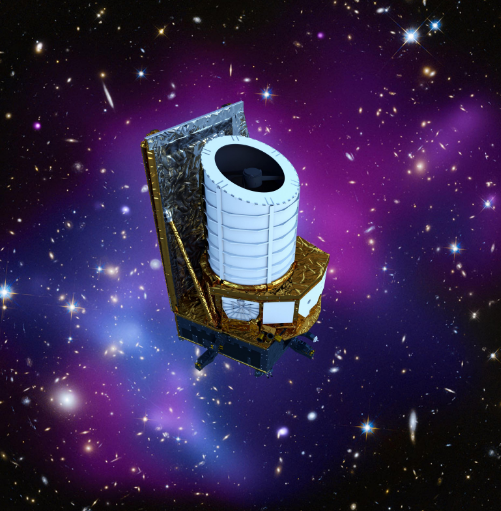
- Agency: European Space Agency.
- Launched: 1 July 2023.
- Studies dark matter, dark energy and the large-scale structure of the universe.
- Provides observations relevant to understanding galaxy formation and evolution.
Significance of the Discovery
- Understanding galaxy evolution: Explains how large galaxies grow through mergers.
- Reconstructing cosmic history: Helps trace the Milky Way's evolution over billions of years.
- Understanding stellar populations: Identifies stars formed outside the Milky Way.
- Improving cosmological models: Provides observational evidence to test theories of galaxy formation.
- Understanding the Local Group: Helps explain interactions among the Milky Way and its neighbouring galaxies.
UPSC Prelims MCQ
Q. The term 'Galactic Archaeology' refers to:
- A. Study of planets outside the Solar System.
- B. Reconstruction of a galaxy's evolutionary history using the age, chemical composition and motion of stars.
- C. Study of black holes exclusively.
- D. Measurement of the expansion rate of the universe.