
29 October 2026
5 topics in this edition
THE HINDU EDITORIAL: “THE SIR VERDICT, SERIOUS CONSTITUTIONAL QUESTIONS”
UPSC Relevance: GS Paper II: POLITY | PRELIMS
CONTEXT
- The Supreme Court’s May 27, 2026 verdict on the Special Intensive Revision (SIR) of electoral rolls in Bihar, upheld the legality of the SIR exercise and recognised the Election Commission of India’s authority to conduct it. However, questions remain about the implementation of voter verification, citizenship inquiries and safeguards against the wrongful exclusion of eligible voters.

Supreme Court Verdict: Key Points
In its May 27, 2026 judgment, the Supreme Court upheld the Bihar SIR exercise. The Court held that:
- The ECI has the authority to conduct SIR under Article 324 of the Constitution, read with Section 21(3) of the Representation of the People Act, 1950.
- Electoral roll revision serves the legitimate objective of ensuring accurate voter lists and free and fair elections.
- The ECI can conduct a limited inquiry into citizenship eligibility for electoral registration.
- Aadhaar may be accepted as proof of identity for electoral-roll purposes, but it is not proof of citizenship.
- The right to vote is constitutionally significant but is subject to legal eligibility requirements and verification procedures.
What Is SIR?
- Special Intensive Revision (SIR) is a comprehensive process undertaken by the Election Commission of India (ECI) to verify and update electoral rolls.
Objectives
- Remove names of deceased voters.
- Identify duplicate entries.
- Update records of voters who have shifted residence.
- Include eligible voters who are missing from electoral rolls.
- Verify the eligibility of individuals registered as voters.
Key Concerns Regarding SIR
- Risk of disenfranchisement: Eligible voters may be excluded because of documentation or verification difficulties.
- Administrative burden: Large-scale verification requires adequate staff, time and clear procedures.
- Transparency: Voters should know why their names have been excluded or flagged.
- Digital divide: Technology-dependent processes can disadvantage people with limited digital access.
- Burden of proof: Excessive documentation requirements may disproportionately affect poor and vulnerable groups.
- Public confidence: Electoral-roll revisions must be impartial and perceived as fair by all stakeholders.
Important Constitutional and Legal Provisions
| Provision | Relevance |
|---|---|
| Article 324 | Powers and functions of the Election Commission. |
| Article 325 | One general electoral roll; prohibits exclusion from electoral rolls solely on grounds of religion, race, caste or sex. |
| Article 326 | Elections to the Lok Sabha and State Assemblies based on adult suffrage. |
| Representation of the People Act, 1950 — Section 16 | Disqualifications for registration in an electoral roll. |
| Representation of the People Act, 1950 — Section 19 | Conditions for registration as an elector. |
| Representation of the People Act, 1950 — Section 21 | Preparation and revision of electoral rolls. |
| Representation of the People Act, 1950 — Section 24 | Appeals relating to electoral-roll decisions. |
Way Forward
- Clear guidelines: Establish transparent and uniform criteria for verification and deletion.
- Due process: Provide notice, an opportunity to respond and a reasoned decision before removing a disputed entry.
- Accessible documentation: Ensure that eligible voters have practical ways to establish their identity and eligibility.
- Transparency: Publish appropriate information about exclusions and provide accessible correction and appeal mechanisms.
- Independent oversight: Ensure judicial scrutiny where allegations of illegality or arbitrary exclusion arise.
- Voter awareness: Inform citizens about deadlines, required documents and the procedures for correcting electoral-roll entries.
- Balance accuracy with inclusion: Protect electoral integrity without creating unnecessary barriers for eligible voters.
UPSC/UPPSC Prelims Practice
Q1. Consider the following statements regarding SIR:
- Article 324 deals with the powers of the Election Commission of India.
- Article 326 provides for elections based on adult suffrage.
- Electoral-roll revision is governed primarily by the Representation of the People Act, 1951.
Which of the statements given above are correct?
(A) 1 only
(B) 1 and 2 only
(C) 2 and 3 only
(D) 1, 2 and 3
UPSC Mains Practice Question
Q.“Electoral-roll accuracy is essential for free and fair elections, but the process of voter verification must not result in the exclusion of eligible citizens.” Discuss in the context of the Supreme Court’s verdict on the Special Intensive Revision of electoral rolls.
DISINVESTMENT AS A KEY ECONOMIC STRATEGY
Why in News?
- The Government of India uses disinvestment to mobilise resources, improve the efficiency of Public Sector Enterprises (PSEs), and reduce its ownership in selected commercial enterprises.
What Is Disinvestment?
- Disinvestment refers to the sale of a part or all of the Government of India's ownership stake in a Public Sector Enterprise (PSE). The government may sell shares to private investors, institutional investors or the public through the stock market.

Important distinction
| Term | Meaning |
|---|---|
| Disinvestment | Sale of some or all government equity in a public sector enterprise. |
| Strategic disinvestment | Transfer of a substantial government stake, usually along with management control, to another entity. |
| Privatisation | Transfer of ownership and/or management control from the public sector to the private sector. |
| Asset monetisation | Generating revenue from public assets, often while retaining ownership, such as through leasing or concession agreements. |
Why Is Disinvestment a Key Economic Strategy?
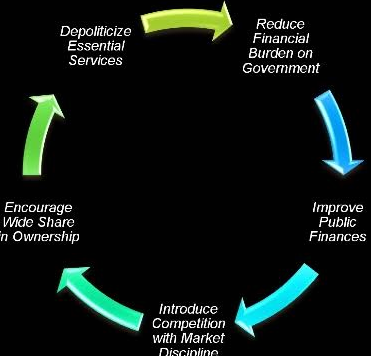
- The Government of India uses disinvestment to improve the management of public assets, mobilise resources and encourage wider public participation in the ownership of public sector enterprises.
- According to the official DIPAM Disinvestment Policy, the policy has two major components:
- Strategic Disinvestment/Privatisation
- Minority Stake Sale
Major Objectives
- Fiscal Consolidation: Generate non-debt capital receipts for the government.
- Resource Mobilisation: Release public funds for infrastructure, healthcare, education and other priorities.
- Operational Efficiency: Encourage better management, technology adoption and productivity.
- Public Participation: Allow citizens to participate in the ownership of public enterprises.
- Competition: Encourage private investment and competition in suitable sectors.
- Better Asset Utilisation: Improve returns on government investments.
How it work in India?
- The Department of Investment and Public Asset Management (DIPAM), under the Ministry of Finance, manages matters relating to the government's equity investments in Central Public Sector Enterprises (CPSEs).
Major Methods of Disinvestment
| Method | Explanation |
|---|---|
| Initial Public Offering (IPO) | Shares of an unlisted company are offered to the public for the first time. |
| Further Public Offering (FPO) | An already listed company issues additional shares or offers existing shares to the public. |
| Offer for Sale (OFS) | Existing shareholders sell shares through the stock exchange mechanism. |
| Strategic Sale | A substantial government stake is sold along with management control. |
| Buyback | A company repurchases its own shares, potentially reducing the government's shareholding when it participates in the transaction. |
New Public Sector Enterprise Policy, 2021
- The New Public Sector Enterprise Policy was notified on 4 February 2021.
- Its objective is to minimise the government's presence in public sector commercial enterprises while retaining a bare minimum presence in designated strategic sectors.
Four Broad Strategic Sectors
The policy identifies strategic sectors based on considerations including:
- National security
- Energy security
- Critical infrastructure
- Provision of financial services and availability of important minerals
Why Is Disinvestment Important for the Indian Economy?
- Fiscal Management: Disinvestment receipts can help finance government priorities without directly increasing public borrowing.
- Infrastructure Development: The proceeds can support infrastructure and other public priorities, depending on government budgetary decisions.
- Private Investment: Strategic investors may bring additional capital, technology, managerial expertise and access to markets.
- Capital Market Development: Listing public sector enterprises and selling minority stakes can increase the supply of shares available to investors and deepen capital markets.
- Better Governance: Public listing and a broader shareholder base can increase disclosure requirements and scrutiny of corporate performance.
Major Challenges Associated with Disinvestment
| Challenge | Explanation |
|---|---|
| Undervaluation of assets | Government assets may be sold below their fair economic value. |
| Employment concerns | Restructuring may affect employees, working conditions or job security. |
| Private monopolies | Privatisation without effective competition may create dominant private firms. |
| Strategic concerns | Excessive dependence on private entities may be undesirable in sensitive sectors. |
| Market conditions | Weak investor demand may reduce sale proceeds. |
| Revenue uncertainty | Disinvestment receipts can fluctuate considerably between financial years. |
| Political and administrative delays | Valuation, approvals, litigation and stakeholder resistance can delay transactions. |
| Loss of future income | Selling a profitable enterprise may reduce future government dividend receipts. |
Way forward
- Disinvestment should be guided by transparent valuation, competitive bidding, protection of public interest, effective regulation and a clear assessment of the long-term costs and benefits.
UPSC Prelims Practice Questions
Q. Consider the following statements about disinvestment:
- Every disinvestment results in the transfer of management control to a private entity.
- Minority stake sales can take place without transferring management control.
- DIPAM functions under the Ministry of Finance.
Which of the statements given above are correct?
(A) 1 only
(B) 1 and 2 only
(C) 2 and 3 only
(D) 1, 2 and 3
IS GRAP ENOUGH TO CURB AIR POLLUTION?
Why Is in News?
- A CREA analysis of 12 episodes (2022–2026) found that Delhi’s air quality worsened in the week after GRAP restrictions intensified in 10 episodes. Winter AQI showed no consistent long-term improvement, raising concerns about GRAP’s effectiveness without proving it caused pollution to rise.
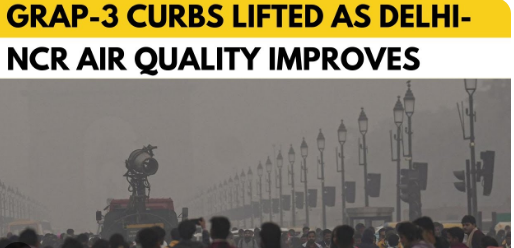
What Is GRAP (Graded Response Action Plan) ?
- GRAP is a set of emergency measures implemented to control air pollution in the National Capital Region (NCR), particularly Delhi, when air quality deteriorates. It operates through different stages based on the severity of air pollution.
- Implementing authority: Commission for Air Quality Management (CAQM).
- Objective: To reduce pollution quickly by imposing graded restrictions on activities that contribute to poor air quality.
How Does GRAP Work?
It uses four stages, with progressively stricter measures as air quality deteriorates. The revised schedule also brings certain preventive measures into force at earlier stages.
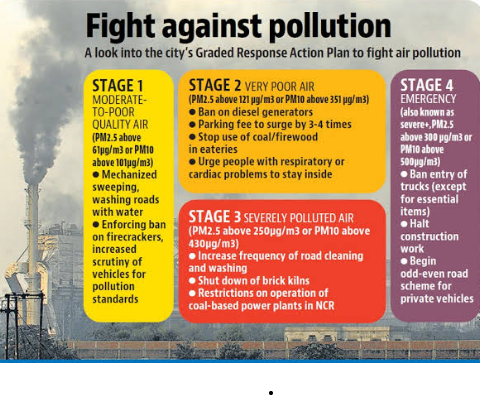
| GRAP Stage | AQI Category | AQI Range | Major Measures |
|---|---|---|---|
| Stage I | Poor | 201–300 | Road dust control, mechanised sweeping, water sprinkling and restrictions on open waste burning. |
| Stage II | Very Poor | 301–400 | Restrictions on polluting activities, improved public transport and traffic management. |
| Stage III | Severe | 401–450 | Restrictions on construction and demolition, and certain polluting vehicles. |
| Stage IV | Severe+ | Above 450 | Stricter restrictions on trucks, construction activities and other sources of pollution. |
Why GRAP Alone Is Insufficient?
- Reactive rather than preventive: GRAP measures are often intensified after pollution has already deteriorated. By then, people may have experienced several days of harmful exposure.
- Persistent pollution sources: Emergency restrictions cannot independently resolve the structural causes of pollution, including:
- Vehicular emissions.
- Industrial emissions.
- Construction and road dust.
- Waste burning.
- Agricultural residue burning.
- Household and commercial fuel combustion.
- Adverse meteorological conditions: During winter, low wind speeds and temperature inversions can trap pollutants near the ground. These conditions make it harder for pollution to disperse.
- Regional nature of air pollution: Pollution does not respect administrative boundaries. Delhi's air quality is influenced by emissions across the wider NCR and Indo-Gangetic Plain.
- Implementation gaps: Weak monitoring, inadequate enforcement, limited public transport and inconsistent compliance can reduce the effectiveness of restrictions.
- Lack of sustained improvement: The recent CREA analysis found no consistent improvement in Delhi's winter air quality over the four winters examined.
What Should Be Done Beyond GRAP?
| Area | Required Measures |
|---|---|
| Transport | Expand reliable public transport, strengthen last-mile connectivity and accelerate the transition to cleaner vehicles. |
| Industry | Enforce emission standards, monitor industrial clusters and promote cleaner technologies. |
| Road dust | Improve road maintenance, mechanised sweeping and scientific dust suppression. |
| Construction | Enforce dust-control standards and ensure proper handling of construction and demolition waste. |
| Stubble burning | Promote crop-residue management, machinery access and economically viable alternatives to burning. |
| Waste management | Prevent open burning and improve waste collection, segregation and processing. |
| Regional coordination | Coordinate pollution-control measures across Delhi, Haryana, Uttar Pradesh, Rajasthan and other affected regions. |
| Monitoring | Improve emissions inventories, air-quality forecasting and source-apportionment studies. |
Key Institutional Mechanisms
- CAQM: Coordinates air-pollution management across Delhi-NCR and adjoining areas.
- CPCB: Monitors air quality and implements environmental responsibilities under its statutory framework.
- State Pollution Control Boards: Monitor and regulate pollution within their jurisdictions.
- Commission for Air Quality Management in NCR and Adjoining Areas Act, 2021: Provides the statutory framework for CAQM.
Way Forward
From Emergency Response to Structural Reform India needs a two-track strategy.
Track 1 — Immediate response
- Implement GRAP promptly when required.
- Improve pollution forecasting and early warnings.
- Enforce restrictions consistently.
- Protect children, older people and other vulnerable groups from excessive exposure.
Track 2 — Long-term prevention
- Reduce emissions throughout the year.
- Shift towards cleaner transport and industrial technologies.
- Develop regional airshed-based pollution-control plans.
- Strengthen public transport and waste management.
- Establish measurable emission-reduction targets and independent monitoring.
UPSC Mains Practice Question
Q. “The limitations of the Graded Response Action Plan demonstrate that emergency restrictions alone cannot solve Delhi-NCR's air pollution crisis.” Discuss.
PM VGSY: Pradhan Mantri Viksit Gram Swaraj Yojana
Why Is in News?
- On 28 October 2026, the Union Cabinet approved the Pradhan Mantri Viksit Gram Swaraj Yojana (PM VGSY), a Centrally Sponsored Scheme aimed at strengthening rural local governance and empowering Gram Panchayats.
About PM VGSY
| Feature | Details |
|---|---|
| Full form | Pradhan Mantri Viksit Gram Swaraj Yojana |
| Type | Centrally Sponsored Scheme (CSS) |
| Approved by | Union Cabinet |
| Approval date | 28 October 2026 |
| Total financial outlay | ₹7,395.55 crore |
| Duration | 2026–27 to 2030–31 |
| Central share | ₹4,869.48 crore |
| State share | ₹2,526.07 crore |
| Nodal level | Gram Panchayats and rural local bodies |
| Main focus | Local planning, digital governance, capacity building and financial accountability |
| Vision | Viksit Bharat |
- Coverage More than 2.55 lakh Panchayats and traditional local bodies across all States and Union Territories.
- Direct beneficiaries Approximately 32 lakh elected representatives, Panchayat functionaries and other stakeholders.
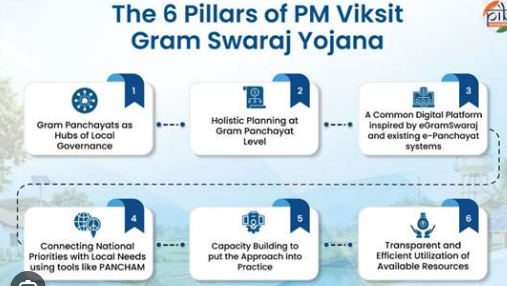
- Key objective: To transform Gram Panchayats into capable, digitally connected, transparent and financially accountable institutions of local self-government.
- The scheme's five-year implementation period coincides with the Sixteenth Finance Commission period.
Major Objectives and Functions
A. Strengthening Gram Panchayats
- Improve the administrative and technical capacity of Panchayats.
- Enable elected representatives to plan and implement local development activities.
- Make Panchayats more accountable to citizens.
B. Integrated Village Development Planning
- Prepare comprehensive Gram Panchayat Development Plans (GPDPs).
- Integrate local needs with relevant Central and State government schemes.
- Identify gaps in village infrastructure and public services.
- Improve coordination between government departments.
C. Digital Governance
- Build on existing platforms such as eGramSwaraj.
- Integrate information about government schemes, beneficiaries, community assets and available resources.
- Improve monitoring and evidence-based decision-making.
D. Capacity Building
- Train elected representatives and Panchayat functionaries.
- Improve their understanding of planning, budgeting and financial management.
- Provide technical assistance to strengthen implementation.
E. Financial Accountability
- Promote online accounting and auditing.
- Improve public disclosure of Panchayat finances.
- Strengthen the mobilisation of Own Source Revenue (OSR).
- Encourage efficient utilisation of Finance Commission grants.
Important Targets Under the Scheme
| Indicator | Target |
|---|---|
| Panchayats covered | More than 2.55 lakh |
| Direct governance beneficiaries | Around 32 lakh |
| Citizens reached per awareness campaign | At least 1 crore |
| Gram Panchayat Development Plans | At least 2.55 lakh annually |
| Online audit plans | At least 2.55 lakh annually |
Important Digital Platforms
1. eGramSwaraj
- Supports Panchayat planning, budgeting, accounting and monitoring.
- Helps improve transparency in Panchayat administration.
2. AuditOnline
- Facilitates online auditing of Panchayati Raj Institutions.
- Supports financial accountability and timely audits.
3. PANCHAM
- An AI-enabled, multilingual communication platform.
- Supports information sharing about government schemes, training and Panchayat services.
- Provides two-way communication in 17 Indian languages.
Constitutional Provision: Panchayati Raj
PM VGSY is relevant to the constitutional framework of decentralisation and grassroots democracy.
| Constitutional Provision | Significance |
|---|---|
| Article 40 | Directs the State to organise village Panchayats and endow them with necessary powers. |
| Article 243 | Defines key terms relating to Panchayats. |
| Article 243A | Gram Sabha. |
| Article 243G | Powers, authority and responsibilities of Panchayats. |
| Article 243H | Powers to impose taxes and establish Panchayat funds, subject to law. |
| Article 243I | State Finance Commission. |
| Article 243K | Elections to Panchayats. |
73rd Constitutional Amendment Act, 1992
- Gave constitutional status to Panchayati Raj Institutions.
- Introduced Part IX of the Constitution.
- Strengthened decentralised rural governance
Significance for India
- Good governance: Improves transparency and accountability in village administration.
- Participatory democracy: Encourages Gram Sabhas and citizens to participate in local planning.
- Inclusive rural development: Helps Panchayats identify local needs and coordinate development programmes.
- Fiscal decentralisation: Improves the capacity of local bodies to use available grants and mobilise their own revenue.
- Digital India: Promotes technology-based planning, accounting and monitoring at the grassroots.
- Sustainable Development Goals (SDGs): Supports progress towards locally relevant development goals through improved planning and coordination.
UPSC Prelims Practice Questions
Q. Consider the following statements regarding PM VGSY:
- It is a Centrally Sponsored Scheme.
- It was approved by the Union Cabinet in October 2026.
- Its implementation period is 2026–27 to 2030–31.
- It is restricted to rural local bodies in one State.
Which of the statements given above are correct?
(A) 1 and 2 only
(B) 1, 2 and 3 only
(C) 2 and 4 only
(D) 1, 2, 3 and 4
Salt Marshes
What are Salt Marshes?
- Salt marshes are coastal wetlands that are flooded and drained by salt water brought in by the tides. They are dominated by salt-tolerant plants (halophytes), especially grasses, sedges and herbs.
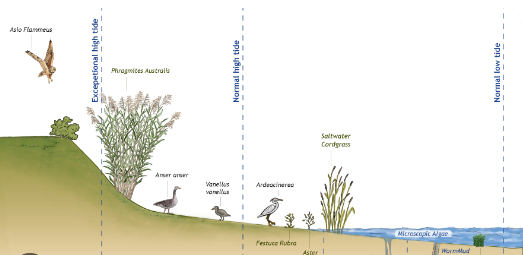
Key Characteristics
| Feature | Description |
|---|---|
| Location | Low-lying coastal areas, estuaries and sheltered bays |
| Salinity | High or variable due to seawater and evaporation |
| Tidal influence | Regularly flooded by tides |
| Vegetation | Salt-tolerant plants called halophytes |
| Soil | Waterlogged, muddy and often oxygen-poor |
| Biodiversity | Supports fish, crustaceans, molluscs and birds |
Ecological Importance
- Coastal protection: Reduces wave energy and helps limit coastal erosion.
- Carbon sequestration: Stores carbon in waterlogged soils; this is part of blue carbon ecosystems.
- Biodiversity: Provides feeding, breeding and nursery habitats for many species.
- Water purification: Traps sediments and can retain excess nutrients and certain pollutants.
- Fisheries support: Provides nursery grounds for commercially important fish and shellfish.
- Flood mitigation: Can absorb and temporarily store coastal floodwater.
Salt Marshes in India
Salt-marsh vegetation occurs in several Indian coastal regions, particularly in sheltered intertidal areas and estuaries. Examples include parts of:
- Gulf of Kachchh, Gujarat
- Gulf of Khambhat, Gujarat
- Sundarbans coastal region
- Selected estuarine and coastal wetlands along the eastern and western coasts
Major Threats
- Coastal development and land reclamation
- Pollution and nutrient enrichment
- Changes in freshwater flow and sediment supply
- Sea-level rise and coastal erosion
- Conversion of wetlands for agriculture or aquaculture
- Invasive species
UPSC Practice MCQ
Q. Consider the following statements about salt marshes:
- They are commonly found in intertidal coastal areas.
- Their vegetation includes salt-tolerant plants.
- They can contribute to long-term carbon storage.
- They occur exclusively in tropical regions.
Which of the statements given above are correct?
(A) 1 and 2 only
(B) 1, 2 and 3 only
(C) 2, 3 and 4 only
(D) 1, 2, 3 and 4