
24 October 2026
5 topics in this edition
Legislative Councils in India
UPSC Mains -GS Paper II — Polity & Governance
- Indian Constitution—historical underpinnings, evolution, features, amendments, significant provisions and basic structure.
- Structure, organization and functioning of the Executive and the Judiciary—Ministries and Departments of the Government; pressure groups and formal/informal associations and their role in the Polity.
What is a Legislative Council?
A Legislative Council (Vidhan Parishad) is the Upper House of the state legislature. It is a permanent legislative body that functions alongside the Legislative Assembly in states having a bicameral legislature.
- Article 168: Provides for the legislatures of states, including bicameral legislatures.
- Article 169: Parliament may create or abolish a State Legislative Council.
- Article 171: Deals with the composition of Legislative Councils.
- Article 172: A Legislative Council is a permanent body; approximately one-third of its members retire every two years.
Bicameral vs Unicameral Legislature
Bicameral
Two Houses
- Legislative Assembly (Vidhan Sabha)
- Legislative Council (Vidhan Parishad)
Unicameral
One House
- Legislative Assembly (Vidhan Sabha)
B. Composition of a Legislative Council — Article 171
The total strength of a Legislative Council:
- Cannot exceed one-third of the strength of the State Legislative Assembly.
- Cannot ordinarily be less than 40 members, subject to the constitutional exception for certain
existing councils.
- The Council is not directly elected by all voters of the state.
| Category | Approximate share |
|---|---|
| Elected by local authorities | 1/3 |
| Elected by graduates | 1/12 |
| Elected by teachers | 1/12 |
| Elected by MLAs | 1/3 |
| Nominated by the Governor | 1/6 |
The Governor nominates 1/6th members with special knowledge or practical experience in literature, science, art, the cooperative movement and social service.
C. How is a Legislative Council created or abolished?
Article 169 establishes a two-stage process:
- The State Legislative Assembly passes a resolution by:
- A majority of the total membership of the Assembly; and
- A majority of not less than two-thirds of the members present and voting.
- Parliament passes a law creating or abolishing the Council.
Important concept: The Assembly's resolution does not itself create or abolish the Council. Parliament must enact a law.
Such a law is passed through the ordinary legislative process and is not treated as a constitutional amendment under Article 368.
D. Powers and functions
| Area | Legislative Council's role |
|---|---|
| Ordinary bills | Can delay up to four months and suggest amendments, but the Assembly can ultimately prevail |
| Money bills | Cannot introduce a Money Bill; can only recommend changes, must be returned within 14 days. |
| Financial control | Cannot permanently block the Assembly's financial decisions |
| Executive accountability | No-confidence motion against the state government is decided in the Assembly |
| Legislative review | Provides an opportunity for reconsideration, expert debate and scrutiny |
| Permanent nature | Cannot be dissolved; members have staggered retirement |
Unlike Parliament, a state legislature has no provision for a joint sitting to resolve a disagreement between the two Houses.
E. Political and constitutional debate
Arguments in favour
- Provides a revising chamber to improve legislation.
- Offers representation to teachers, graduates and local authorities.
- Allows experts and experienced individuals to contribute to policymaking.
- Can reduce the risk of hurried legislation.
Arguments against
- May become a political rehabilitation platform for defeated leaders.
- Can delay legislative decisions.
- Adds administrative and financial costs.
- May duplicate the work of the Legislative Assembly.
UPSC Prelims practice
Q1. Consider the following statements regarding State Legislative Councils:
- A Legislative Council is subject to dissolution every five years.
- Parliament can create or abolish a Legislative Council under Article 169.
- The Governor nominates one-sixth of the Council's members.
- A Money Bill can originate in either House of a bicameral state legislature.
Which of the statements given above are correct?
- A. 1 and 2 only
- B. 2 and 3 only
- C. 1, 3 and 4 only
- D. 2, 3 and 4 only
India–US Relations: Marco Rubio’s Visit to India
GS Paper II- International Relations
- Based on the newspaper article “Falling short” — Marco Rubio’s second visit to India and its implications for bilateral relations.
1. Why is this news important?
- The article examines US Secretary of State Marco Rubio’s visit to India amid continuing differences over trade, tariffs, energy purchases and foreign policy. It highlights a central question: Can India and the United States sustain their strategic partnership despite political and economic disagreements?
- The visit provides a useful case study of diplomatic engagement, strategic autonomy and the challenges of managing bilateral relations in a changing global order.
Key Point
A. Strategic Partnership
- A long-term relationship based on shared interests in defence, technology, trade and regional security.
- UPSC angle: Strategic cooperation does not require complete agreement on every international issue.
B. Strategic Autonomy
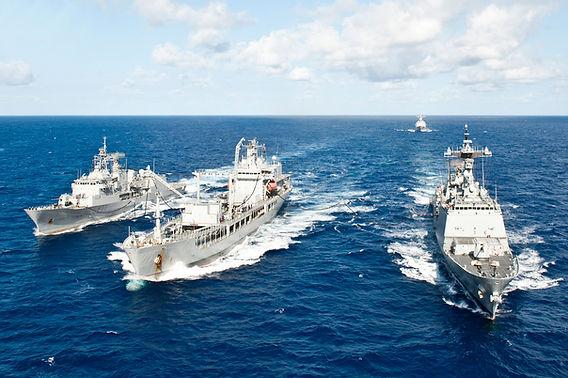
India's ability to make independent foreign-policy decisions according to its national interests while maintaining partnerships with different countries.
UPSC angle: Cooperation with the US can coexist with India's independent relations with Russia and other powers.
C. Trade Diplomacy
The use of negotiations, tariffs, market access and economic agreements to advance national interests.
UPSC angle: Trade disputes can affect broader diplomatic and strategic cooperation.
D. Indo-Pacific Cooperation
Collaboration on maritime security, regional stability, freedom of navigation and a rules-based regional order.
3. Background: India–US relations
India and the United States maintain a Comprehensive Global Strategic Partnership covering defence, trade, energy, technology and regional security. The October 2026 visit took place amid concerns over tariffs, energy policy and differences in regional diplomacy.
Major areas of cooperation
| Area | Importance for India |
|---|---|
| Defence | Modernisation, defence technology and joint exercises |
| Trade | Export opportunities, investment and employment |
| Energy | Diversification of oil and energy supplies |
| Technology | Semiconductors, AI, space and critical technologies |
| Indo-Pacific | Maritime security and regional stability |
| Multilateral cooperation | Quad and cooperation on global challenges |
- India–US defence cooperation includes foundational agreements such as LEMOA, COMCASA and BECA. The two countries also cooperate through the Quad, along with Japan and Australia.
4. Challenges in India–US relations
Trade and tariff disputes:
- Differences over tariffs, market access and domestic economic priorities can undermine mutual confidence.
Energy security and Russia:
- India seeks affordable and reliable energy supplies, while US policy toward Russian energy can create diplomatic and economic pressure.
Different geopolitical priorities:
- Differences over Pakistan, China, Russia and other international issues can complicate cooperation.
Transactional diplomacy:
- If relations are driven primarily by immediate economic or political concessions, long-term strategic trust may weaken.
- These tensions do not eliminate the shared interests that underpin the relationship, but they demonstrate the need for sustained dialogue and practical agreements.
5. Way forward
- Institutionalise dialogue: Strengthen regular diplomatic, trade and defence consultations.
- Resolve trade differences: Pursue mutually beneficial arrangements that protect legitimate domestic interests.
- Preserve strategic autonomy: Base decisions on India's national interests rather than external pressure.
- Diversify partnerships: Deepen cooperation with the US while maintaining constructive relations with other major powers.
- Focus on deliverables: Convert diplomatic visits into measurable outcomes in technology, energy, investment and security.
UPSC Mains question
GS Paper II — 250 words
“India–US relations demonstrate that strategic convergence does not eliminate economic and geopolitical differences.” Discuss in the context of India's pursuit of strategic autonomy.
India–China Border Issue
GS Paper II: International Relations | GS Paper III: Security
The India–China border issue remains significant because of continuing tensions along the Line of Actual Control (LAC), particularly in Arunachal Pradesh, despite renewed diplomatic and military engagement.
Geographical Division of the India–China Border
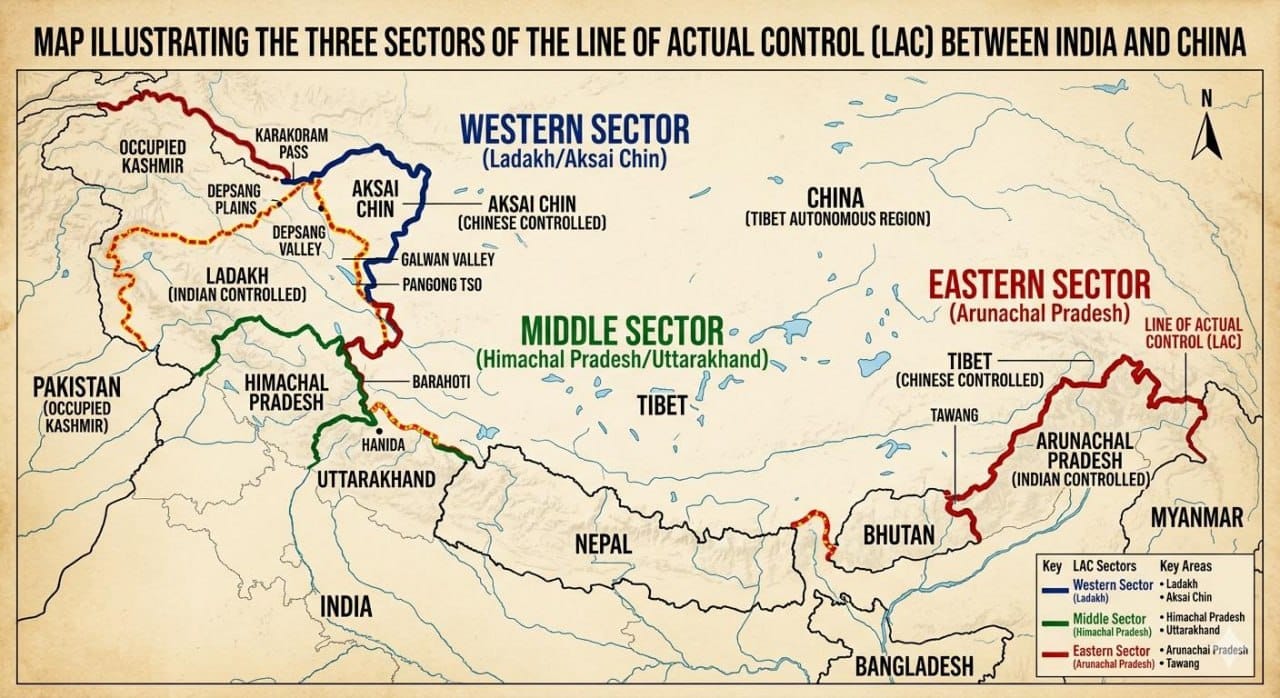
India and China share a disputed boundary of approximately 3,488 km, according to India's official position. The dispute is generally divided into three sectors.
| Sector | Major areas | Main dispute |
|---|---|---|
| Western | Ladakh, Aksai Chin | China controls Aksai Chin, which India claims as part of Ladakh |
| Middle | Himachal Pradesh, Uttarakhand | Smaller areas of differing boundary perceptions |
| Eastern | Arunachal Pradesh, Sikkim | China claims Arunachal Pradesh; India rejects these claims |
Important territorial facts
- Aksai Chin: Administered by China and claimed by India.
- Arunachal Pradesh: Administered by India; China claims much of it as part of its territory.
- McMahon Line: The boundary line agreed upon between British India and Tibet at the 1914 Simla Convention; China rejects its validity.
- LAC: The Line of Actual Control separates areas under Indian and Chinese control but is not a mutually agreed, fully delineated international boundary. Press Information Bureau
Why Does the Border Dispute Persist?
- Different perceptions of the LAC: Both countries claim different alignments in certain areas, creating overlapping patrolling zones.
- Historical disagreements: India and China interpret historical agreements and territorial claims differently.
- Strategic importance: Aksai Chin provides China with a strategically important link between Xinjiang and Tibet.
- Infrastructure development: Roads, bridges, airfields and military infrastructure improve logistics but can intensify strategic competition.
- Tibet factor: Tibet's political status and China's control over the Tibetan Plateau have important implications for India's security.
- Trust deficit: The 2020 Galwan Valley clash severely damaged bilateral relations.
The absence of a mutually agreed alignment of the entire LAC remains a central source of friction. Press Information Bureau
Important India–China Border Agreements
| Year Agreement / mechanism Significance |
|---|
| 1993 Agreement on Maintenance of Peace and Tranquillity Established a framework for maintaining peace along the LAC |
| 1996 Agreement on Confidence-Building Measures Provided military confidence-building measures and restrictions |
| 2005 Political Parameters and Guiding Principles Agreement Established principles for a negotiated boundary settlement |
| 2012 Working Mechanism for Consultation and Coordination (WMCC) Facilitates diplomatic and military coordination on border affairs |
| 2013 Border Defence Cooperation Agreement (BDCA) Strengthened cooperation and procedures for managing border incidents |
| 25 Aug 2026: 25th Special Representatives' Talks |
| 6 Sep 2026: Military talks in Arunachal Pradesh |
| 23 Oct 2026: the MEA reiterated that tensions can arise when Chinese forces deviate from established patrolling patterns. |
Line of Actual Control (LAC)
It is the line separating areas under Indian control from areas under Chinese control.
| Feature Details |
|---|
| Full form Line of Actual Control |
| Countries India and China |
| Nature De facto line separating areas under their respective control |
| Total length Commonly cited as approximately 3,488 km, according to India's official position on the disputed border |
| Main issue Different perceptions of the LAC's alignment in certain areas |
| Western sector Eastern Ladakh and Aksai Chin |
| Middle sector Himachal Pradesh and Uttarakhand |
| Eastern sector Sikkim and Arunachal Pradesh |
| Major conflict Galwan Valley clash, June 2020 |
Indo-Tibetan Border Police (ITBP)
The Indo-Tibetan Border Police (ITBP) is a Central Armed Police Force (CAPF) responsible for guarding India's border with China.
| Feature | Details |
|---|---|
| Full form | Indo-Tibetan Border Police |
| Established | 24 October 1962 |
| Background | Established following the 1962 India–China War |
| Administrative ministry | Ministry of Home Affairs (MHA) |
| Legal framework | Indo-Tibetan Border Police Force Act, 1992 |
| Primary responsibility | Guarding the India–China border |
| Border length guarded | Approximately 3,488 km |
| Headquarters | New Delhi |
| Motto | Shaurya–Dridhata–Karma Nishtha (Valour, Steadfastness, Devotion to Duty) |
| Personnel | Known as Himveers |
| Special capabilities | High-altitude operations, mountaineering, skiing and disaster rescue |
Way Forward
- Clarify the LAC: Renew efforts to establish a common understanding of its alignment.
- Strengthen confidence-building measures: Improve communication between military commanders and prevent accidental escalation.
- Maintain deterrence: Develop border infrastructure and operational preparedness while avoiding unnecessary escalation.
- Pursue diplomatic engagement: Continue Special Representatives' talks and WMCC meetings.
- Separate cooperation from confrontation carefully: Expand cooperation where possible without compromising India's territorial interests.
- Protect water security: Strengthen dialogue on the Brahmaputra and transboundary river data.
- Build strategic resilience: Reduce critical supply-chain vulnerabilities and strengthen domestic capabilities.
Shamonda Virus
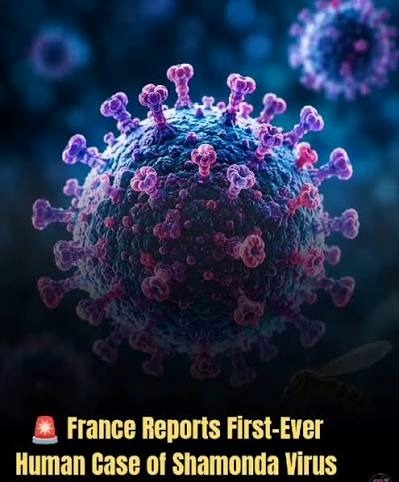
Shamonda virus (SHAV) is an animal-associated, vector-borne virus that primarily affects livestock. In October 2026, France reported the first documented human infection.
ABOUT IT:
| Feature | fact |
|---|---|
| Virus | Shamonda virus (SHAV) |
| Virus family | Peribunyaviridae |
| Genus | Orthobunyavirus |
| Group | Simbu serogroup |
| First isolated | Cattle in Nigeria, 1965 |
| Primary hosts | Cattle, sheep and goats; also reported in horses and alpacas |
| Vector | Biting midges of the genus Culicoides |
| Transmission | Primarily between animals through infected midge bites |
| First documented human case | France, October 2026 |
| Vaccine | No established vaccine currently available |
| Human-to-human transmission | No evidence reported so far |
Symptoms and Impact
In animals:
- Fever and diarrhoea.
- Reduced milk production.
- Reproductive problems, including abortions.
- Foetal malformations in infected pregnant animals.
In humans:
- Only one documented case has been reported so far.
- The patient was severely immunocompromised and developed neurological complications.
- The patient died in early October 2026; investigations into the infection's role in the death are ongoing.
- French authorities have reported no identified risk to the general population at present. Santé Publique France
UPSC Prelims MCQs
Q1. Shamonda virus belongs to which genus?
- A. Flavivirus
- B. Orthobunyavirus
- C. Coronavirus
- D. Filovirus
Oskar Klein Medal 2026
Why in the News?
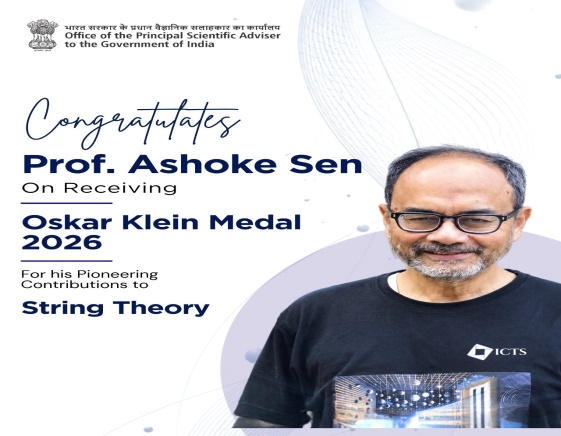
Indian theoretical physicist Ashoke Sen has received the 2026 Oskar Klein Medal, becoming the first Indian physicist to receive this prestigious honour. The International Centre for Theoretical Sciences (ICTS), Bengaluru, announced the award on 22 October 2026.
Important Facts for Prelims
| Feature | information |
|---|---|
| Award | Oskar Klein Medal |
| Award year | 2026 |
| Recipient | Ashoke Sen |
| Field | Theoretical Physics |
| Awarded by | Stockholm University and the Nobel Committee for Physics of the Royal Swedish Academy of Sciences |
| Established | 1988 |
| Named after | Oskar Klein, Swedish theoretical physicist |
| Institution associated with Sen | International Centre for Theoretical Sciences (ICTS), Bengaluru |
| Major research areas | String theory, black hole entropy and string field theory |
| Associated lecture | Oskar Klein Memorial Lecture |
Why Did Ashoke Sen Receive the Medal?
His work has made important contributions to three areas:
1. String Theory
- Attempts to describe fundamental particles as tiny vibrating strings.
- Seeks a theoretical framework that incorporates quantum mechanics and gravity.
2. S-duality
- A theoretical symmetry relating strong and weak coupling regimes in certain physical theories.
- Helps physicists understand difficult problems using equivalent descriptions.
3. Black Hole Entropy
- Entropy is related to the number of microscopic states associated with a black hole.
- Sen's research contributed to the precise counting of black hole microstates in theoretical models.
Other Major Awards Received by Ashoke Sen
| Year | Award |
|---|---|
| 1989 | ICTP Prize |
| 1994 | Shanti Swarup Bhatnagar Prize |
| 2001 | Padma Shri |
| 2009 | Infosys Prize in Mathematical Sciences |
| 2012 | Breakthrough Prize in Fundamental Physics |
| 2013 | Padma Bhushan |
| 2014 | Dirac Medal |
He was elected a Fellow of the Royal Society in 1998.
Prelims Practice Question
Q. With reference to the Oskar Klein Medal, consider the following statements:
- It recognises distinguished contributions to physics.
- It is named after a Swedish theoretical physicist.
- Ashoke Sen became the first Indian physicist to receive it in 2026.
- It is awarded by the Nobel Foundation as a Nobel Prize category.
Which of the statements given above are correct?
- A. 1 and 2 only
- B. 1, 2 and 3 only
- C. 2, 3 and 4 only
- D. 1, 2, 3 and 4