
5 November 2026
7 topics in this edition
05th Nov 2026 News
Editorial: Anaemia Burden – Iron Alone Is No Solution
GS Paper II – Health
Context

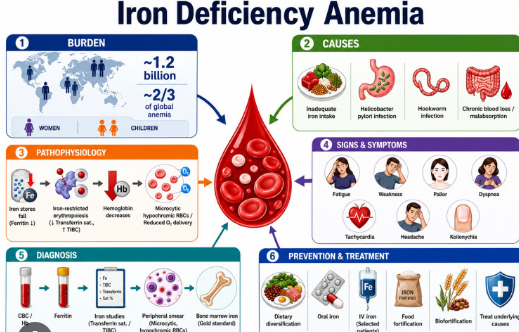
India continues to face a high burden of anaemia, particularly among women and children. The question is whether Double Fortified Salt (DFS), containing iron and iodine, can effectively address this problem. According to NFHS-5:
- More than 50% of women are anaemic.
- Approximately two-thirds of young children are anaemic.
What is Double Fortified Salt (DFS)?
- Common salt fortified with iron and iodine.
- Intended to address iron deficiency and iodine deficiency.
- Proposed as a population-level intervention because salt is widely consumed.
Why Is Iron Alone Not the Solution?
| Issue | Explanation |
|---|---|
| Multiple causes | Anaemia can result from iron, Vitamin B12 and folate deficiencies, infections and genetic disorders. |
| Poor absorption | Non-haem iron absorption is affected by phytates, polyphenols and calcium. |
| Unequal intake | Women and children may consume less salt than adult men, although they have a high anaemia burden. |
| Excess iron | Unnecessary iron intake can cause iron overload in susceptible individuals. |
| Infection | Inflammation increases hepcidin, which reduces iron absorption and availability. |
| Existing programmes | Fortified rice and iron-folic acid supplementation may lead to overlapping iron exposure. |
Health Risks and Policy Contradictions
A. Conflict with salt reduction
- WHO recommends less than 5 grams of salt per day for adults.
- India aims to reduce population salt consumption by 30% under its NCD action plan.
- Promoting salt as an iron-delivery vehicle may create conflicting public health messages.
B. Risk of iron overload
- The body has no regulated mechanism to eliminate excess iron efficiently.
- Iron accumulation can cause oxidative stress and organ damage.
- Patients with certain haemoglobin disorders, including thalassaemia, may be particularly vulnerable.
C. Evidence from international studies
- Pemba trial, Tanzania (2006): Iron and folic acid supplementation in children in a malaria-endemic setting was associated with increased hospitalisations and deaths.
- Kenya (2015): A trial raised concerns about changes in infant gut microbiota and diarrhoea following iron-fortified food consumption.
Other Causes of Anaemia
| Nutritional causes | Non-nutritional causes |
|---|---|
| Iron deficiency | Malaria |
| Vitamin B12 deficiency | Hookworm infection |
| Folate deficiency | Chronic inflammation |
| Vitamin A deficiency | Haemoglobinopathies |
| Protein-energy malnutrition | Menstrual and pregnancy-related blood loss |
Important genetic disorders:
- Beta-thalassaemia
- Sickle cell disease
Government Initiatives
| Initiative | Objective |
|---|---|
| Anaemia Mukt Bharat (2018) | Reduce anaemia through a comprehensive strategy |
| POSHAN Abhiyaan | Improve nutritional outcomes |
| PM POSHAN | Improve nutritional status of schoolchildren |
| Saksham Anganwadi and POSHAN 2.0 | Address malnutrition among children and women |
| National Deworming Day | Reduce worm infestation |
| National Health Mission | Strengthen public healthcare services |
Anaemia Mukt Bharat – 7×7×7 Strategy
- 7 beneficiaries: Children, adolescents, women of reproductive age, pregnant and lactating women and other specified target groups.
- 7 interventions: Iron-folic acid supplementation, deworming, behaviour change, testing and treatment, fortified foods, malaria control and addressing non-nutritional causes.
- 7 institutional mechanisms: Coordination, convergence and monitoring across different levels of implementation.
Way Forward
- Targeted supplementation: Provide iron according to actual nutritional requirements.
- Better diagnosis: Combine haemoglobin testing with ferritin, Vitamin B12 and inflammation assessment where appropriate.
- Dietary diversity: Promote affordable foods rich in iron, folate, Vitamin B12 and protein.
- Disease control: Strengthen malaria prevention, deworming, sanitation and infection control.
- Targeted fortification: Conduct monitored district-level pilots before large-scale implementation of DFS.
- Genetic screening: Strengthen screening and counselling for sickle cell disease and thalassaemia.
Mains Practice Question
Q.“Anaemia is a multidimensional public health challenge that cannot be addressed through iron supplementation alone.” Critically examine. (250 words)
UPSC Prelims MCQ
Q. Consider the following statements regarding anaemia:
- All cases of anaemia are caused by iron deficiency.
- Vitamin B12 and folate deficiencies can cause anaemia.
- Certain haemoglobinopathies can contribute to anaemia.
- Ferritin is used to assess iron stores in the body.
Which of the statements given above are correct?
- A. 1 and 2 only
- B. 2, 3 and 4
- C. 1, 3 and 4 only
- D. All four
Donald Trump's Lame-Duck Presidency
GS Paper II: US political system, executive-legislature relations
GS Paper III: Global economy, trade and energy security
Context
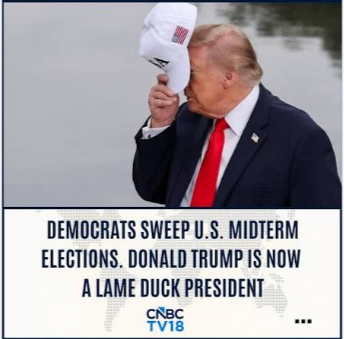
Following the US midterm elections of 3 November 2026, Democrats have secured control of both chambers of Congress, weakening Trump's legislative influence during the remaining two years of his presidency.
What is a Lame-Duck President?
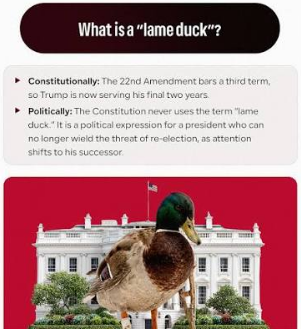
A lame-duck president is an elected leader whose political influence and ability to shape future policies decline because their departure from office is approaching or their political support has weakened.
In the US, the term traditionally refers to the period after a successor has been elected but before the incumbent leaves office.
Why Is Donald Trump Being Called a Lame Duck?
- Loss of congressional control: Democrats have gained control of the House of Representatives and Senate.
- Reduced legislative influence: Passing new laws and approving budgets will become more difficult.
- Political setback: The election results are being interpreted as a rejection of aspects of Trump's governance.
- Internal party pressure: Republican leaders may become less willing to follow his political direction.
- 2028 succession debate: Attention is shifting towards the next presidential election and possible Republican successors.
Implications for Trump's Presidency
| Area | Possible implications |
|---|---|
| Legislative agenda | Greater difficulty passing bills and budget proposals |
| Presidential appointments | Senate confirmation of nominees may become difficult |
| Congressional oversight | Increased investigations into administration policies |
| Impeachment | Democrats may initiate impeachment proceedings, though removal requires constitutional thresholds |
| Executive orders | Greater reliance on executive actions |
| Veto power | Trump can veto bills passed by Congress; overriding a veto requires a two-thirds majority in both chambers |
Important: Losing congressional control does not mean losing presidential powers. Trump remains President until January 2029 and retains constitutional executive authority.
Impact on Global Affairs
- Trade and tariffs: Greater uncertainty over US trade policy may affect international supply chains.
- Global economy: Political uncertainty may influence financial markets, investment and economic growth.
- Energy security: US policy towards Iran and the Middle East could affect global oil prices.
- China policy: Congressional opposition may influence the domestic political environment surrounding US-China relations.
- International institutions: Foreign policy decisions may become more unpredictable during the remaining presidential term.
Does a Lame-Duck President Become Powerless?
No. The US President retains:
- Executive powers under Article II of the US Constitution.
- Authority over several foreign policy decisions.
- The power to veto legislation.
- The power to issue executive orders within constitutional and statutory limits.
- Powers relating to military command and diplomacy.
However, Congress retains legislative, budgetary and oversight powers.
Comparative Analysis
| Basis | USA – President | India – Prime Minister |
|---|---|---|
| Government system | Presidential | Parliamentary |
| Executive head | President | Prime Minister |
| Tenure | Fixed 4 years | Normally 5 years for Lok Sabha; PM's tenure depends on majority support |
| Election | Indirectly elected through Electoral College | Appointed by President; normally leader commanding Lok Sabha majority |
| Executive-legislature relationship | Separation of powers | Fusion of powers |
| Legislative accountability | Not dependent on congressional confidence | Collectively responsible to Lok Sabha |
| Loss of majority | Does not automatically remove President | Government may fall |
| Midterm elections | Can change control of Congress without changing President | No equivalent nationwide midterm election |
| Removal | Impeachment process | Loss of confidence, resignation or other constitutional processes |
| Lame-duck situation | Possible during remaining presidential term | Political influence can decline, but government may continue if it retains Lok Sabha confidence |
UPSC Prelims MCQs
Q. Consider the following statements regarding the US political system:
- The US Congress consists of the House of Representatives and the Senate.
- The President can veto a bill passed by Congress.
- A presidential veto can be overridden by a simple majority in both chambers.
- Midterm elections are held halfway through the presidential term.
Which of the statements given above are correct?
- A. 1 and 2 only
- B. 1, 2 and 4 only
- C. 2 and 3 only
- D. 1, 2, 3 and 4
Mains Practice Question
Q. How does divided government in the United States affect executive-legislative relations and its foreign policy? Discuss its possible implications for India. (125 words)
Cyclone Murasu
Why in News?
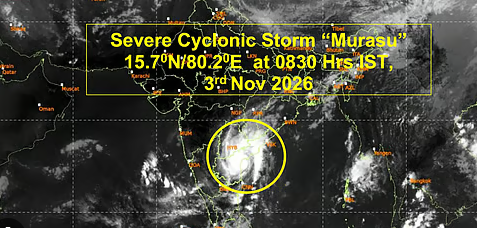
Cyclone Murasu developed over the Bay of Bengal and made landfall on the Andhra Pradesh coast near Ongole on 3 November 2026. It reached the intensity of a Severe Cyclonic Storm before landfall and weakened after landfall and was reported as a deep depression on 4 November 2026.
Important Facts about Murasu
| Parameter | Details |
|---|---|
| Name | Murasu (Murasu) means (War drum) |
| Basin | Bay of Bengal |
| Landfall | South Andhra Pradesh coast |
| Landfall region | Between Nellore and Narsapur, close to Ongole |
| Landfall date | 3 November 2026 |
| Peak intensity | Severe Cyclonic Storm |
| Maximum wind speed | 100–110 km/h |
| Main affected region | Andhra Pradesh and adjoining areas |
| Naming contribution | India |
Formation of Tropical Cyclones
Tropical cyclones develop over warm ocean waters through the interaction of several atmospheric and oceanic conditions.
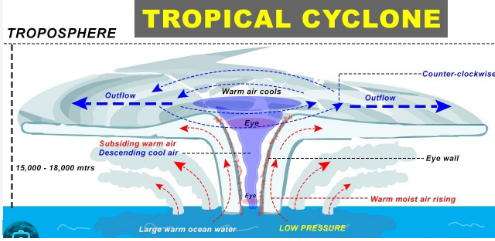
Favourable conditions:
- Sea surface temperature generally around 26.5°C or above.
- Sufficient Coriolis force.
- High atmospheric moisture.
- Low vertical wind shear.
- Pre-existing low-pressure disturbance.
- Upper-level divergence that allows rising air to be replaced.
Major Impacts and Vulnerable Areas
- Heavy to very heavy rainfall over coastal Andhra Pradesh and adjoining regions.
- Risk of flooding in low-lying coastal areas.
- Damage to crops, houses, electricity poles and transport infrastructure.
- Disruption of fishing and coastal economic activities.
- Lightning and thunderstorms continued in parts of Andhra Pradesh after the cyclone weakened.
The Andhra Pradesh disaster-management dashboard reported provisional agricultural crop inundation of approximately 1.23 lakh hectares in its 4 November 2026 update.
Why Is the Bay of Bengal More Cyclone-Prone?
| Bay of Bengal | Arabian Sea |
|---|---|
| Generally higher frequency of cyclones | Historically lower frequency |
| Large river systems bring freshwater | Relatively higher salinity |
| Warm waters and favourable atmospheric conditions | Increasingly favourable conditions for cyclone formation |
| Densely populated deltaic and coastal regions | Several vulnerable coastal regions |
Reasons for cyclone formation in the Bay of Bengal
- High sea surface temperatures.
- High atmospheric moisture.
- Monsoon-related wind circulation.
- Low-pressure systems developing over the northern Indian Ocean.
Cyclone Classification – IMD
| Category | Maximum sustained wind speed |
|---|---|
| Depression | 31–49 km/h |
| Deep Depression | 50–61 km/h |
| Cyclonic Storm | 62–88 km/h |
| Severe Cyclonic Storm | 89–117 km/h |
| Very Severe Cyclonic Storm | 118–166 km/h |
| Extremely Severe Cyclonic Storm | 167–221 km/h |
| Super Cyclonic Storm | 222 km/h or more |
Cyclone Naming Mechanism
- Cyclones over the North Indian Ocean are named under the WMO/ESCAP Panel on Tropical Cyclones.
- The panel includes 13 countries: India, Bangladesh, Myanmar, Pakistan, Sri Lanka, Thailand, Maldives, Oman, Iran, Qatar, Saudi Arabia, UAE and Yemen.
- Each member contributes names to a common list.
- India Meteorological Department (IMD), New Delhi, is the Regional Specialized Meteorological Centre (RSMC) responsible for issuing tropical cyclone advisories for the North Indian Ocean.
Institutions Involved in Cyclone Management
| Institution | Role |
|---|---|
| IMD | Cyclone forecasting and early warnings |
| NDMA | National disaster-management policy and guidelines |
| NDRF | Search, rescue and relief operations |
| SDMA | State-level disaster management |
| INCOIS | Ocean information and tsunami-related services |
| Indian Coast Guard | Coastal safety and rescue |
| RSMC New Delhi | Regional tropical cyclone advisories |
Government Initiatives
- National Cyclone Risk Mitigation Project (NCRMP): Reduces cyclone vulnerability in coastal states.
- National Disaster Management Plan: Provides a framework for disaster preparedness and response.
- Early Warning Systems: Improve forecasting and timely evacuation.
- SACHET Portal: Disseminates location-specific disaster alerts.
- Impact-Based Forecasting: Focuses on expected impacts rather than only weather parameters.
- Coalition for Disaster Resilient Infrastructure (CDRI): Promotes disaster-resilient infrastructure.
Challenges in Cyclone Management
- Inadequate cyclone-resistant housing.
- Coastal erosion and storm surges.
- Damage to agriculture and fisheries.
- Displacement of coastal communities.
- Gaps in last-mile early warning communication.
- Increasing risks associated with climate change and sea-level rise.
Way Forward
- Strengthen multi-hazard early warning systems.
- Develop cyclone-resilient infrastructure.
- Promote mangrove restoration and coastal ecosystem protection.
- Improve evacuation shelters and community preparedness.
- Strengthen disaster insurance and livelihood rehabilitation.
- Integrate climate adaptation into coastal planning.
UPSC Prelims MCQs
Q. With reference to tropical cyclone formation, consider the following statements:
- Warm ocean water provides energy for tropical cyclones.
- A strong Coriolis force is necessary for cyclone formation.
- High vertical wind shear generally favours tropical cyclone intensification.
- High atmospheric moisture supports cyclone development.
Which of the statements given above are correct?
- A. 1 and 2 only
- B. 1, 2 and 4 only
- C. 1, 3 and 4 only
- D. 2 and 3 only
Mains Practice Question
Q. Tropical cyclones are recurring natural hazards along India's eastern coast. Examine the vulnerability of the Bay of Bengal region. (250 words)
Prelims Pointer
Public Accounts Committee (PAC)
GS Paper II – Indian Polity
Why in News?
The two-day All-India Conference of Chairpersons of Public Accounts Committees of Parliament and State/UT Legislatures held in Thiruvananthapuram, Kerala, on 3–4 November 2026. The conference was inaugurated by Lok Sabha Speaker Om Birla.
Its theme was: “Audit, Accountability and Good Governance – The Evolving Role of the Public Accounts Committee.”
About PAC
The Public Accounts Committee (PAC) is a parliamentary financial committee that examines how the government spends public money and whether expenditure has been incurred in accordance with parliamentary authorisation.
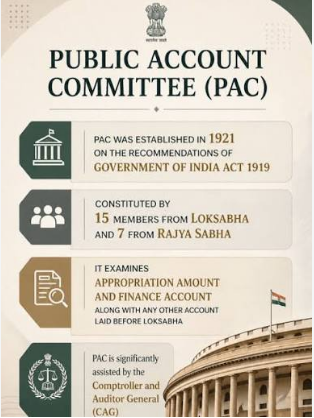
- Established in 1921 under the Government of India Act, 1919.
- It is one of the oldest parliamentary committees.
- It is a Financial Standing Committee.
- It examines the reports of the Comptroller and Auditor General (CAG).
Composition
| Feature | Details |
|---|---|
| Total members | 22 |
| Lok Sabha | 15 members |
| Rajya Sabha | 7 members |
| Election | Elected annually by Parliament |
| Election method | Proportional representation by single transferable vote |
| Tenure | One year |
| Chairman | Appointed by the Speaker of Lok Sabha |
| Minister as member | Cannot be a member |
Functions of PAC
- Examines appropriation accounts of the government.
- Examines finance accounts of the Union Government.
- Examines CAG reports submitted to Parliament.
- Checks whether public money was spent for the purpose approved by Parliament.
- Identifies financial irregularities, wasteful expenditure and cases of financial mismanagement.
- Examines whether expenditure has been incurred in accordance with the prescribed rules and procedures.
Limitations of PAC
- It cannot itself authorise expenditure.
- It does not examine the government's policy decisions as such.
- Its recommendations are advisory, not legally binding.
- It generally examines expenditure after it has been incurred.
- It cannot directly enforce recovery or punishment.
PAC vs Estimates Committee vs COPU
| Basis | PAC | Estimates Committee | Committee on Public Undertakings |
|---|---|---|---|
| Members | 22 | 30 | 22 |
| Lok Sabha | 15 | 30 | 15 |
| Rajya Sabha | 7 | 0 | 7 |
| Main function | Examines government expenditure | Examines estimates and suggests economy and efficiency | Examines public sector undertakings |
| CAG reports | Examines relevant reports | Not its primary function | Examines relevant reports relating to PSUs |
| Chairman | Speaker appoints | Speaker appoints | Speaker appoints |
Role of CAG in PAC
- CAG audits government receipts and expenditure.
- CAG reports are submitted to the President or Governor, as applicable.
- The President lays Union CAG reports before Parliament under Article 151.
- PAC examines relevant CAG reports and questions government departments about irregularities.
- CAG assists PAC in its examination.
Constitutional and Legal Provisions
| Article | Provision |
|---|---|
| Article 148 | Office of Comptroller and Auditor General |
| Article 149 | Duties and powers of CAG |
| Article 150 | Form of accounts of Union and States |
| Article 151 | Submission of CAG reports |
Importance of PAC
- Strengthens legislative control over public expenditure.
- Promotes financial accountability.
- Ensures transparency in government spending.
- Helps prevent misuse of public funds.
- Strengthens parliamentary oversight of the executive.
Challenges
- Delay in examination of CAG reports.
- Recommendations are not binding.
- Limited time and resources.
- Government departments may delay providing information.
- Increasing complexity of public expenditure.
Way Forward
- Ensure timely examination of CAG reports.
- Strengthen follow-up on PAC recommendations.
- Improve technical and financial expertise.
- Ensure transparency in government responses.
- Strengthen parliamentary financial oversight.
UPSC Prelims MCQs
Q. With reference to the Public Accounts Committee, consider the following statements:
- It consists of 22 members.
- It includes members from both Lok Sabha and Rajya Sabha.
- Ministers can be members of the committee.
- Its members are elected annually.
Which of the statements given above are correct?
- A. 1 and 2 only
- B. 1, 2 and 4 only
- C. 2 and 3 only
- D. All four
Swachh Bharat Mission (Gramin) – Phase II
UPSC Prelims + GS Paper II & III
Why in News?
According to a report published in The Indian Express on 4 November 2026, the Centre has extended Swachh Bharat Mission (Gramin) Phase II until 31 March 2028.
- The extension aims to enable all remaining villages to achieve ODF Plus status.
- Around ₹7,000 crore is expected to be provided in the Union Budget 2027–28.
- The government has set 31 March 2028 as the deadline for completing the remaining work.
About the SBM(G)
| Particular | Details |
|---|---|
| Launch of original SBM | 2 October 2014 |
| Phase II approved | 19 February 2020 |
| Nodal Ministry | Ministry of Jal Shakti |
| Department | Department of Drinking Water and Sanitation |
| Type | Centrally Sponsored Scheme |
| Original Phase II period | 2020–21 to 2024–25 |
| Current extended deadline | 31 March 2028 |
| Total approved outlay | ₹1,40,881 crore |
| Main objective | ODF sustainability and ODF Plus villages |
Main Objectives
- Sustain Open Defecation Free (ODF) status.
- Ensure no one is left behind in sanitation coverage.
- Promote Solid Waste Management (SWM).
- Promote Liquid Waste Management (LWM).
- Ensure visual cleanliness in rural areas.
- Encourage community participation and behavioural change.
ODF Plus – Three Categories
| Category | Criteria |
|---|---|
| ODF Plus Aspiring | Sustains ODF status and has arrangements for either solid or liquid waste management. |
| ODF Plus Rising | Sustains ODF status and has arrangements for both solid and liquid waste management. |
| ODF Plus Model | Sustains ODF status, has both waste-management arrangements and maintains visual cleanliness. |
Visual cleanliness includes:
- Minimal litter.
- Minimal stagnant wastewater.
- No plastic waste dumps in public places.
- Display of ODF Plus IEC messages.
Financial Provisions
Total approved outlay: ₹1,40,881 crore
Funding pattern for major components:
| Region | Centre : State |
|---|---|
| North-Eastern and Himalayan States, including J&K | 90:10 |
| Other States | 60:40 |
| Union Territories | 100% Central funding |
Sources of funding:
- Central and State Government budgets.
- 15th Finance Commission grants.
- MGNREGA convergence.
- Other permissible revenue-generation mechanisms.
Challenges
- Sustainability: Maintaining toilet usage and ODF behaviour.
- Waste management: Inadequate waste collection and treatment infrastructure.
- Greywater: Improper disposal of household wastewater.
- Behavioural change: Continued community participation is essential.
- Funding: Timely release and effective utilisation of funds.
- Monitoring: Ensuring that declared ODF Plus status reflects actual ground conditions.
Way Forward
- Strengthen Gram Panchayat-level sanitation planning.
- Promote waste segregation at source.
- Develop decentralised composting and wastewater treatment.
- Encourage community participation through Jan Bhagidari.
- Strengthen digital monitoring and third-party verification.
- Integrate sanitation with public health and environmental protection.