
26 October 2026
5 topics in this edition
The Hindu Editorial: “New Avenues”
UPSC Mains -GS Paper II — Polity & Governance
Why Is in News?
Polish Prime Minister Donald Tusk visited India from 21–23 October 2026. The visit aimed to strengthen economic, technological and defence cooperation.

RELATIONS BETWEEN INDIA- POLAND:
A. Strategic Partnership
- Established: August 2024, during Prime Minister Narendra Modi's visit to Poland.
- Action Plan: 2024–2028.
- Diplomatic relations: Established in 1954.
- Objective: Expand cooperation in trade, defence, technology, energy and security.
It reflects India's effort to diversify its European partnerships and strengthen its engagement with Central and Eastern Europe.
B. Bilateral Trade: Target for 2030
India and Poland aim to double bilateral trade by 2030, from approximately $6 billion to $12 billion.
Potential areas of cooperation include:
- Pharmaceuticals and chemicals.
- Engineering goods and industrial machinery.
- Information technology and digital services.
- Agriculture and food processing.
- Mining and critical minerals.
UPSC relevance: Trade diversification, export promotion and India's economic engagement with Europe.
C. Defence Cooperation
Both countries are seeking to deepen defence-industrial cooperation.
Important areas include:
- Defence manufacturing.
- Joint ventures and industrial partnerships.
- Technology collaboration.
- Co-development and co-production of defence equipment.
- Counter-terrorism cooperation.
A proposed Defence Industry Dialogue would provide a platform for discussing these opportunities.
Defence partnerships can strengthen India's domestic manufacturing capacity and support the Make in India initiative. PM India
D. Critical Minerals and Emerging Technologies
India and Poland have opportunities to cooperate in:
| Sector | Strategic importance |
|---|---|
| Critical minerals | Reduce supply-chain vulnerabilities |
| Semiconductors | Strengthen advanced electronics manufacturing |
| Artificial Intelligence | Improve productivity and technological capabilities |
| Battery recycling | Support electric mobility and the circular economy |
| Space technology | Expand scientific and commercial cooperation |
| Renewable energy | Advance energy transition and sustainability |
E. The Russia–Ukraine War: A Major Geopolitical Challenge
This is one of the most important analytical aspects of the editorial.
Poland's perspective:
- Poland is a member of NATO and the European Union.
- The Russia–Ukraine war has major implications for its national security.
- Poland is concerned about Russian military activity and regional stability.
India's perspective:
- India maintains longstanding defence and strategic ties with Russia.
- India advocates dialogue and diplomacy to resolve the Ukraine conflict.
- India also seeks to protect its energy security and strategic autonomy.
CHALLENGES:
India and Poland have different perspectives on Russia, even though they have common interests in trade, technology and defence cooperation.
Way forward:
Both countries should avoid allowing disagreements over third countries to undermine mutually beneficial bilateral cooperation.
Closer cooperation can help India:
- Expand exports to European markets.
- Attract European investment.
- Diversify supply chains.
- Strengthen technology partnerships.
- Improve engagement with European institutions.
The broader India–EU relationship is also important for trade, investment, technology and security cooperation.
Mains Practice Question
Q. India–Poland relations demonstrate the importance of economic diplomacy in managing geopolitical differences. Discuss.
Removal of Public Service Commission Chairmen
UPSC Mains -GS Paper II — Polity & Governance
Why is in news?
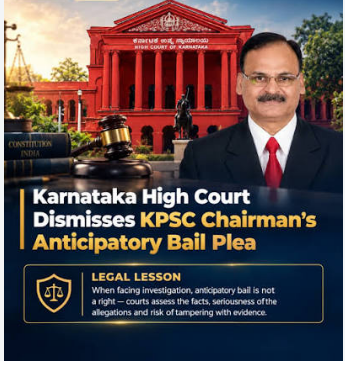
Former Kerala Governor Rajendra Arlekar reportedly recommended the removal of Kerala PSC Chairman M. R. Baiju over alleged recruitment irregularities, triggering a debate on Article 317 and PSC independence.
What is a Public Service Commission?
A Public Service Commission (PSC) is a constitutional body responsible for supporting fair and merit-based recruitment to government services.
- UPSC: Union-level recruitment.
- State PSC: Recruitment to state government services.
- Joint State PSC: A common commission for two or more states, established by Parliament when requested by the concerned state legislatures.
Constitutional Provisions: Articles 315–323
| Article | Provision |
|---|---|
| 315 | Establishment of UPSC and State PSCs |
| 316 | Appointment and term of office of members |
| 317 | Removal and suspension of PSC members |
| 318 | Regulations regarding conditions of service and staff |
| 319 | Restrictions on further employment after leaving office |
| 320 | Functions of PSCs |
| 321 | Extension of PSC functions |
| 322 | Expenses of PSCs |
| 323 | Submission of reports |
Removal and Suspension of PSC Members
Article 317 provides safeguards against arbitrary removal of PSC chairpersons and members.
A. Removal on grounds of misbehaviour
- The President of India issues the removal order.
- The President must refer the matter to the Supreme Court for an inquiry.
- If the Supreme Court reports that removal is warranted, the President may issue the removal order.
B. Other grounds for removal
The President may remove a PSC chairman or member without the Supreme Court inquiry prescribed for misbehaviour if the person:
- Is adjudged insolvent.
- Engages in paid employment outside official duties during the term.
- Is considered unfit to continue due to infirmity of mind or body.
C. Suspension
When a reference concerning misbehaviour has been made to the Supreme Court, the Governor may suspend a member of a State PSC until the President passes an order after receiving the Court’s report.
Appointment and Tenure: Article 316
| Feature | State PSC | UPSC |
|---|---|---|
| Appointment | Governor | President |
| Tenure | Six years or until age 62, whichever is earlier | Six years or until age 65, whichever is earlier |
| Resignation submitted to | Governor | President |
Exam fact: Appointment and removal are governed by different constitutional provisions—Articles 316 and 317, respectively.
Functions of PSCs: Article 320
The functions of PSCs include:
- Conducting examinations for appointments to government services.
- Advising on methods of recruitment.
- Advising on appointments, promotions and transfers.
- Advising on disciplinary matters concerning public servants.
- Performing other functions assigned under the Constitution or by law.
The Constitution provides for consultation with PSCs in specified matters, subject to applicable exceptions.
Why Is PSC Independence Important?
Significance:
- Promotes merit-based recruitment.
- Supports equality of opportunity in public employment under Article 16.
- Helps reduce political interference in recruitment.
- Strengthens administrative neutrality and public trust.
- Promotes transparency and fairness in government appointments.
Challenges
- Allegations of irregularities in examinations.
- Political interference or pressure.
- Delays in recruitment and appointment processes.
- Questions over transparency and accountability.
Way forward: Ensure transparent evaluation, independent investigation of credible allegations, timely recruitment, and strict adherence to constitutional procedures.
Prelims Practice MCQs
Q1. Consider the following statements about Article 317:
- The President issues the final removal order on grounds of misbehaviour after the prescribed Supreme Court inquiry.
- A Governor can independently issue the final removal order for a State PSC chairman.
- The President may remove a PSC member on certain specified grounds without the inquiry prescribed for misbehaviour.
Which of the statements given above are correct?
(A) 1 only
(B) 1 and 2 only
(C) 1 and 3 only
(D) 1, 2 and 3
UPSC Mains Question:
Q. “The constitutional safeguards provided to Public Service Commissions seek to balance institutional independence with accountability.” Discuss.
Where Should Judicial Restraint Begin?
UPSC RELEVANCE: GS Paper II: Indian Constitution, Judiciary, Electoral Reforms | GS Paper IV: Ethics, Impartiality and Judicial Conduct
Why is in the News?
Supreme Court Justice Ujjal Bhuyan's public remarks on voter deletions and the right to vote sparked a debate over judicial restraint, judicial propriety and comments on matters pending before courts (sub judice).
Key Issue:
The central question is-
Should judges publicly express views on constitutional rights when related cases are still pending before the courts?
Two principles must be balanced:
- Protection of constitutional rights: Judges should speak up against arbitrary state action and violations of citizens' rights.
- Judicial impartiality: Judges should avoid public statements that could create the impression that they have already decided a pending case.
The issue is not whether judges can discuss the Constitution, but where constitutional commentary ends and prejudgment of a pending dispute begins.
Judicial Restraint vs Judicial Activism vs Judicial Overreach
| Basis | Judicial Restraint | Judicial Activism | Judicial Overreach |
|---|---|---|---|
| Meaning | Courts exercise power cautiously | Courts actively protect rights and address government inaction | Courts go beyond their legitimate constitutional role |
| Approach | Deference to elected branches within constitutional limits | Proactive interpretation and enforcement of rights | Intrusion into legislative or executive functions |
| Objective | Maintain separation of powers | Ensure justice and protect constitutional values | An excessive or unjustified exercise of judicial power |
| Concern | May lead to insufficient intervention | May blur institutional boundaries | May weaken democratic accountability |
Judicial restraint does not mean silence in the face of constitutional violations. It means exercising judicial power within constitutional limits and maintaining impartiality.
Constitutional Provisions
| Article | Relevance |
|---|---|
| Article 14 | Equality before law and equal protection of laws |
| Article 19 | Fundamental freedoms, including freedom of speech and expression |
| Article 21 | Protection of life and personal liberty |
| Article 32 | Right to approach the Supreme Court for enforcement of Fundamental Rights |
| Article 121 | Restricts discussion in Parliament of the conduct of Supreme Court or High Court judges, except upon a motion for their removal |
| Article 211 | Similar restriction on discussion of judges' conduct in State Legislatures |
| Article 324 | Superintendence, direction and control of elections vested in the Election Commission of India |
| Article 326 | Elections to the Lok Sabha and State Legislative Assemblies based on adult suffrage |
The constitutional text is available through the Legislative Department, Government of India.
Right to Vote and Electoral Rolls:
Justice Bhuyan's remarks also raised questions about the right to vote and the deletion of names from electoral rolls.
Article 326: Adult Suffrage
- Provides for elections to the Lok Sabha and State Legislative Assemblies on the basis of adult suffrage, subject to constitutional and legal qualifications.
- The voting age was reduced from 21 to 18 years by the 61st Constitutional Amendment Act, 1988.
Representation of the People Act, 1950:
- Provides the legal framework for electoral rolls.
- Section 22 deals with correction of entries in electoral rolls, including deletion on specified grounds.
- Electoral roll changes must follow the applicable statutory procedure.
The Election Commission's official manual explains the legal framework for electoral-roll corrections and deletions.
Judicial Propriety and Ethics
Judicial propriety means that judges should conduct themselves in a manner that preserves public confidence in the independence, fairness and impartiality of the judiciary.
Restatement of Values of Judicial Life, 1997:
The Supreme Court adopted an in-house code of judicial conduct that emphasises integrity, impartiality and conduct consistent with public confidence in the judiciary.
It advises judges against publicly expressing views on political matters or cases pending, or likely to arise, for judicial determination.
Why is this important?
- A judge's public remarks may create an impression of prejudgment.
- Parties may question whether they will receive a fair hearing.
- The credibility of the final judgment may be weakened.
- Public disagreement among judges can affect confidence in judicial institutions.
Judicial Independence vs Judicial Accountability:
| Judicial Independence | Judicial Accountability |
|---|---|
| Protects judges from improper external pressure | Requires judges to maintain ethical and professional standards |
| Supports impartial decision-making | Helps maintain public trust |
| Protects constitutional adjudication | Addresses misconduct through appropriate procedures |
| Must not be undermined by political interference | Must not become a tool for intimidating judges |
Balanced approach: Judicial independence should not mean absence of accountability, and accountability should not become a means of controlling judicial decisions.
Way Forward
- Clearer ethical guidance: Update judicial-conduct guidance on public speeches and pending cases.
- Institutional self-regulation: Develop transparent procedures within the judiciary to address ethical concerns.
- Responsible public communication: Judges should distinguish general legal education from comments that appear to prejudge a live dispute.
- Timely judicial decisions: Resolve important constitutional questions without unnecessary delay.
- Protect electoral rights: Ensure electoral-roll revision is transparent, accurate and consistent with applicable law.
- Respect separation of powers: Each constitutional institution should act within its assigned role while remaining accountable under the Constitution.
UPSC Prelims MCQs
Q. Consider the following statements:
- Article 326 deals with adult suffrage for elections to the Lok Sabha and State Legislative Assemblies.
- Article 324 provides for the Election Commission of India's superintendence, direction and control of elections.
- Article 121 prohibits Parliament from discussing the conduct of judges under all circumstances.
Which of the statements given above are correct?
(A) 1 only
(B) 1 and 2 only
(C) 2 and 3 only
(D) 1, 2 and 3
UPSC Mains Practice Question:
Q. “Judicial restraint is essential for preserving judicial impartiality, but excessive restraint may weaken the protection of constitutional rights.” Discuss. (150 words)
Agrivoltaics
UPSC RELEVANCE: GS Paper III: Agriculture, Renewable Energy & Sustainable Development | PRELIMS
What is Agrivoltaics?
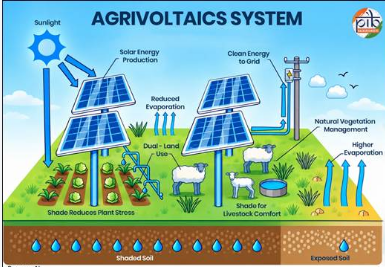
Agrivoltaics is the practice of using the same land for both agriculture and solar power generation by installing solar panels above or alongside crops. It is also called Agri-PV or Agricultural Photovoltaics.
How Does It Work?
- Solar panels generate electricity from sunlight.
- Crops grow beneath or between the panels.
- Panel height, spacing and orientation are adjusted according to crop requirements.
- Some systems also support livestock grazing.
Benefits of Agrivoltaics:
| Benefit | Significance | |
|---|---|---|
| Dual land use | Agriculture and electricity generation on the same land | |
| Additional income | Farmers may earn from electricity generation or land leasing | |
| Water conservation | Partial shading can reduce evaporation and crop water demand | |
| Climate resilience | May protect certain crops from excessive heat and solar radiation | |
| Clean energy | Supports India's renewable energy transition | |
| Rural development | Can create local jobs and diversify farm income |
Important: Benefits depend on crop type, panel design, climate and management. Excessive shading can reduce crop yields.
Challenges:
- High initial installation costs.
- Possible reduction in yields for crops requiring full sunlight.
- Difficulties in operating farm machinery beneath panels.
- Competition over land and unclear ownership or leasing arrangements.
- Need for suitable grid connectivity and maintenance.
- Unequal access for small and marginal farmers.
Relevance to India:
Agrivoltaics may help India address three challenges simultaneously:
- Energy security: Expands solar electricity generation.
- Farmers' income: Creates opportunities for additional revenue.
- Climate adaptation: Can reduce heat stress and water loss in suitable farming systems.
It is particularly worth exploring in water-stressed and high-temperature regions, provided the system is designed around local crops and farming practices.
Related Government Initiatives:
- PM-KUSUM: Promotes solar energy in agriculture, including decentralised renewable energy and solarisation of agricultural pumps.
- National Solar Mission: Supports the expansion of solar energy in India.
- National Action Plan on Climate Change (NAPCC): Provides a broader policy framework for climate mitigation and adaptation.
Prelims Practice MCQs
Q. With reference to agrivoltaics, consider the following statements:
- It combines agricultural production with solar electricity generation on the same land.
- It always increases crop yields.
- It may help reduce evaporation through partial shading.
Which of the statements given above are correct?
(A) 1 only
(B) 1 and 3 only
(C) 1 and 2 only
(D) 1, 2 and 3
Khajuraho Temples: From Chandela Grandeur to UNESCO World Heritage
UPSC RELEVANCE: GS I: Temple Architecture | PRELIMS
Why in the News?
The Archaeological Survey of India (ASI) has identified a sandstone head in its storage facility as the missing head of an approximately seven-foot-tall, 11th-century Vishnu idol at the Javari Temple, Khajuraho. The ASI plans to restore the sculpture after expert examination.
Khajuraho: Important Facts
- Location: Chhatarpur district, Madhya Pradesh.
- Builders: Chandela dynasty, which ruled parts of Bundelkhand.
- Major period of construction: Approximately 10th–11th centuries CE.
- Architectural style: Nagara style of Hindu temple architecture.
- UNESCO status: The Khajuraho Group of Monuments was inscribed on the World Heritage List in 1986.
- Religious traditions: The temples reflect Hindu and Jain traditions.
- Material: Many temples and sculptures are built from sandstone.
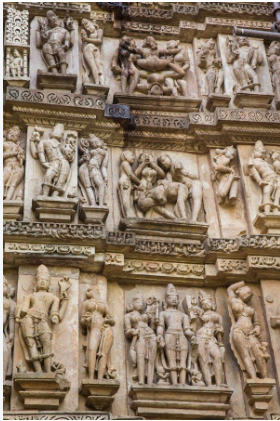
Khajuraho is renowned for its intricate sculptures, richly decorated walls, elevated platforms and towering temple superstructures. The Indian Express
Chandela Dynasty: Historical Background
- The Chandelas were a medieval dynasty associated with the Jejakabhukti region, broadly corresponding to the Bundelkhand area.
- They were important patrons of temple construction, sculpture and regional art.
- Khajuraho's temples represent the political power, religious patronage and artistic achievements of the Chandela period.
- The temples were built over an extended period rather than by a single ruler.
Key Features of Khajuraho Temple Architecture
| Feature | Description |
|---|---|
| Shikhara | Tower above the sanctum, characteristic of Nagara architecture |
| Garbhagriha | Inner sanctum housing the principal deity |
| Mandapa | Pillared hall for worshippers |
| Sculptural decoration | Depictions of deities, celestial beings, dancers and everyday life |
| Sandstone construction | Carefully carved stone blocks used in many temples |
| Religious diversity | Hindu and Jain temples within the larger monument group |
Important example: The Kandariya Mahadeva Temple is among Khajuraho's most celebrated temples, known for its imposing shikhara and elaborate sculptural programme.
Javari Temple and the Vishnu Idol
The Javari Temple is part of Khajuraho's architectural heritage and is associated with the Hindu tradition.
The recent restoration concerns an approximately seven-foot-tall Vishnu sculpture dating to the 11th century.
Key developments:
- The missing sandstone head was reportedly located in an ASI storage facility.
- Its material, colour, proportions and distinctive kirit mukut (crown) helped establish its identification.
- Experts are assessing how to reattach the head safely.
- The circumstances in which the head became detached remain unclear.
UNESCO World Heritage Status
The Khajuraho Group of Monuments was inscribed on the UNESCO World Heritage List in 1986.
Its outstanding cultural value lies in:
- Exceptional medieval Indian temple architecture.
- High-quality stone carving and sculptural artistry.
- Evidence of the region's religious and cultural traditions.
- The artistic achievements of the Chandela period.
Role of the Archaeological Survey of India (ASI)
The ASI operates under the Ministry of Culture and is responsible for archaeological research and the conservation of centrally protected monuments.
Its relevant activities include:
- Conservation and restoration of historic monuments.
- Archaeological surveys and excavations.
- Documentation and preservation of sculptures and artefacts.
- Scientific assessment of damaged heritage structures.
- Protection of archaeological remains under applicable laws.
Challenges in Heritage Conservation
- Weathering and deterioration of stone.
- Theft, vandalism and damage to sculptures.
- Fragmented or incomplete documentation of artefacts.
- Tourism-related pressure on monuments.
- Shortage of specialist conservation expertise and resources.
- Balancing restoration with the preservation of historical authenticity.
Way Forward
- Digitise and regularly update inventories of sculptures and loose fragments.
- Use scientific documentation, photography and 3D scanning.
- Follow evidence-based conservation practices.
- Improve security and monitoring at protected monuments.
- Strengthen collaboration among archaeologists, art historians and conservation scientists.
- Promote responsible tourism and public awareness.
UPSC Prelims Practice Questions
Q. Consider the following statements about Khajuraho:
- The temples are associated with the Chandela dynasty.
- The Khajuraho Group of Monuments was inscribed on the UNESCO World Heritage List in 1986.
- The temples exclusively represent Buddhist religious traditions.
Which of the statements given above are correct?
(A) 1 only
(B) 1 and 2 only
(C) 2 and 3 only
(D) 1, 2 and 3