

UPSC Relevance: GS II | GS III
Source:TH
Context
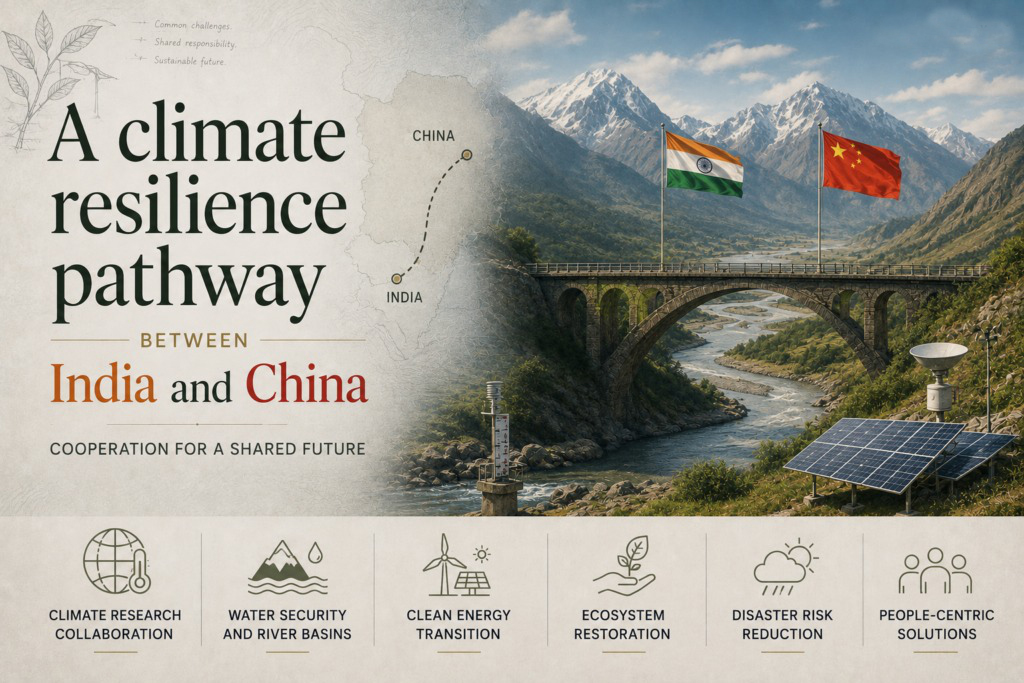
- Amid increasing climate-related disasters and global climate uncertainties, the editorial argues that India and China, the world’s two largest developing countries and major greenhouse gas emitters, should strengthen cooperation on climate resilience, clean energy, and sustainable development, despite their geopolitical differences.
Background
India and China together account for over one-third of the world’s population and are among the largest emitters of greenhouse gases.
Both are highly vulnerable to glacial melt, floods, droughts, heatwaves, sea-level rise, and food insecurity.
While bilateral ties remain strained after the 2020 Galwan clashes, both countries cooperate in multilateral climate negotiations such as:
- UNFCCC
- Paris Agreement
- BASIC Group (Brazil, South Africa, India & China)
- BRICS
- Shanghai Cooperation Organisation (SCO)
Highlights
- Climate change should be viewed as a shared challenge rather than a geopolitical issue.
- India and China can cooperate in:
- Climate adaptation and resilience.
- Renewable energy technologies.
- Disaster risk reduction and early warning systems.
- Himalayan ecosystem and glacier research.
- Sustainable agriculture and water management.
- Joint efforts can strengthen the voice of the Global South in climate negotiations.
- Collaboration can improve access to climate finance and green technologies.
Challenges
- Border disputes and strategic mistrust.
- Competition in the Indo-Pacific region.
- Differences in trade and technology policies.
- Limited data sharing on transboundary rivers and Himalayan glaciers.
- Balancing economic growth with emission reduction commitments.
- Geopolitical rivalry affecting long-term cooperation.
Way Forward
- Separate climate cooperation from broader geopolitical disputes.
- Strengthen scientific collaboration on Himalayan glaciers, monsoon systems, and biodiversity.
- Improve data sharing on weather forecasting and disaster management.
- Promote joint research in renewable energy, green hydrogen, battery storage, and carbon capture technologies.
- Enhance cooperation through BRICS, SCO, BASIC, and G20 platforms.
- Work together to ensure equity and Common but Differentiated Responsibilities (CBDR-RC) remain central to global climate governance.
UPSC Mains Expected Question
- Q. Climate change presents an opportunity for India and China to cooperate despite strategic differences. Discuss the scope, challenges, and significance of India–China cooperation in building climate resilience. (15 Marks)
Keywords for Mains
- Climate Diplomacy
- Climate Resilience
- Green Transition
- Global South
- Energy Transition
- Disaster Resilience
- Sustainable Development
- Ecological Security
- CBDR-RC
- Paris Agreement
