

UPSC Relevance: GS II (Polity & Judiciary) | Prelims
Source: TH
Why is it in News?
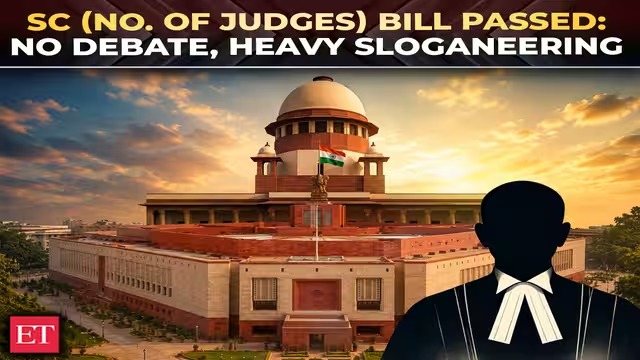
- The Union Government has introduced the Supreme Court Judges (Increase in Number) Amendment Bill, 2026 as a Money Bill to increase the sanctioned strength of Supreme Court judges.
What is the Bill?
- Seeks to increase the sanctioned strength of Supreme Court judges (excluding the Chief Justice of India).
Objective:
- Reduce the huge backlog of pending cases.
- Improve access to justice.
- Ensure faster disposal of cases.
Why is the Money Bill Route Controversial?
- The Bill has been introduced as a Money Bill under Article 110.
- Critics argue that increasing the number of judges does not directly relate to taxation, borrowing, expenditure, or the Consolidated Fund of India, which are the subjects specified under Article 110.
- Since the issue of misuse of the Money Bill route is already under judicial scrutiny, the move has revived the constitutional debate.
What is a Money Bill?
- Constitutional Provision: Article 110 of the Constitution defines a Money Bill.
A Bill is a Money Bill only if it deals exclusively with:
- Taxation, Borrowing of money.
- Custody or withdrawal from the Consolidated Fund of India (CFI) or Contingency Fund of India.
- Appropriation of money.
- Government expenditure.
- Matters incidental to the above.
Special Features of a Money Bill
- Can be introduced only in the Lok Sabha.
- Requires the President’s prior recommendation.
- Speaker of the Lok Sabha certifies whether a Bill is a Money Bill.
- Rajya Sabha cannot amend or reject it; it can only make recommendations.
- Rajya Sabha must return it within 14 days.
- Lok Sabha may accept or reject the recommendations.
Why is This Important?
- A Money Bill limits the role of the Rajya Sabha, affecting bicameral scrutiny.
- Raises questions about the separation of powers and parliamentary accountability.
- May set a precedent for bypassing the Upper House on non-financial legislation.
Supreme Court’s Stand
- Rojer Mathew v. South Indian Bank Ltd. (2019)
- The Supreme Court questioned the use of the Money Bill route for legislation that is not exclusively financial.
- Referred the issue to a larger Bench for authoritative interpretation.
Aadhaar Judgment (2018)
- The Aadhaar Act was upheld as a Money Bill by the majority.
- However, the issue remains under reconsideration by a larger Bench.
Challenges
- Possible dilution of the Rajya Sabha’s constitutional role.
- Risk of misuse of Article 110.
- Judicial uncertainty until the Supreme Court delivers its final verdict.
- Concerns over legislative transparency and federal balance.
Way Forward
- Use the Money Bill route strictly in accordance with Article 110.
- Await the Supreme Court’s final ruling on the scope of Money Bills.
- Preserve bicameralism and constitutional checks and balances.
- Ensure judicial reforms through broad parliamentary consensus.
UPSC Value Addition
- Money Bill (Article 110) : Deals only with specified financial matters.
- Financial Bills (Article 117) : May contain financial as well as other provisions and follow a different legislative procedure.
- Key Pending Issue : Whether Parliament can classify a Bill as a Money Bill when it contains substantial non-financial provisions remains under consideration by a larger Constitution Bench of the Supreme Court.
