

- UPSC Relevance: GS I – Art & Culture | GS II – Constitution, Fundamental Rights & Duties | Prelims
- Source: TH
WHY IN NEWS?
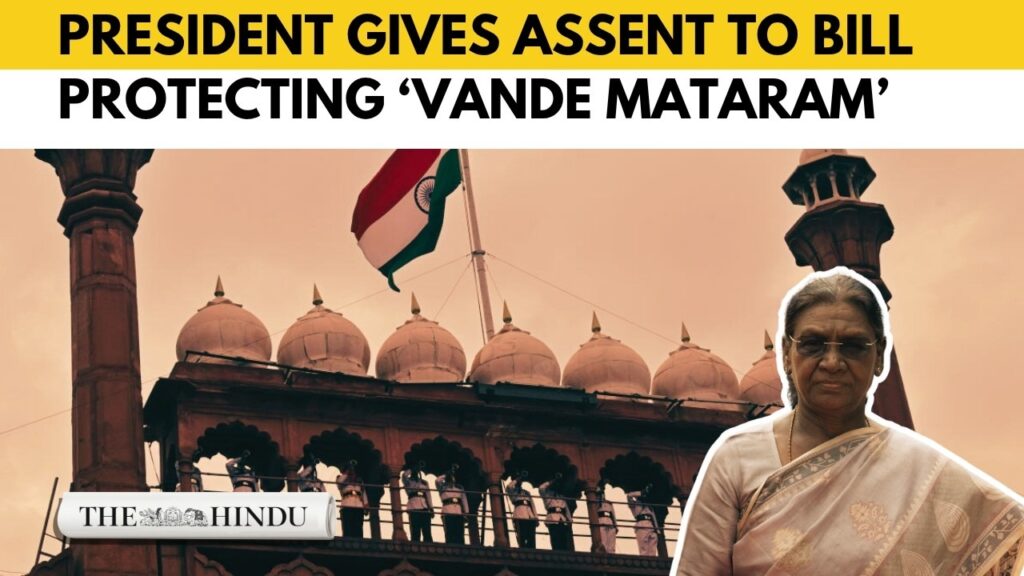
- President Droupadi Murmu has given assent to the Prevention of Insults to National Honour (Amendment) Bill, 2026.
- The amendment extends statutory protection to Vande Mataram, particularly against its intentional disruption or prevention of singing.
WHAT DOES THE NEW LAW PROVIDE?
- Extends the relevant protection under the Prevention of Insults to National Honour Act, 1971 to Vande Mataram.
- Intentional prevention or disturbance of its singing can attract:
- Imprisonment up to 3 years,
- Fine Or both.
- Important: It does not mean that every citizen is automatically required to sing Vande Mataram.
CONSTITUTIONAL STATUS OF NATIONAL SYMBOLS
- National Anthem: Jana Gana Mana
- National Song: Vande Mataram
- Article 51A(a): Fundamental Duty to respect the National Flag and National Anthem.
- The Constitution does not specifically mention Vande Mataram.
HISTORICAL EVOLUTION OF VANDE MATARAM
- Author: Bankim Chandra Chattopadhyay.
- Composed in 1875.
- Incorporated in Anandamath (1882).
- First publicly sung at the 1896 Calcutta Session of the Indian National Congress.
- Became a powerful symbol during the Swadeshi Movement and anti-Partition movement of 1905.
- Recognised as the National Song in 1950.
LEGAL FRAMEWORK: PREVENTION OF INSULTS TO NATIONAL HONOUR ACT, 1971
- The Act primarily protects:
- National Flag
- Constitution
- National Anthem
- 2026 Amendment: Extends relevant statutory protection to Vande Mataram.
FUNDAMENTAL RIGHTS DIMENSION
- The law must operate within the framework of:
- Article 19: Freedom of speech and expression.
- Article 25: Freedom of conscience and religion.
- Article 51A(a): Respect for National Flag and National Anthem.
JUDICIAL SAFEGUARD: BIJOE EMMANUEL CASE, 1986
- In Bijoe Emmanuel v. State of Kerala:
- Students belonging to Jehovah’s Witnesses did not sing the National Anthem due to their religious beliefs. They nevertheless stood respectfully.
- Supreme Court protected their Fundamental Rights.
- Principle: Respect for a national symbol does not necessarily mean compelled participation in its rendition.
NATIONAL UNITY vs CONSTITUTIONAL PLURALISM
The issue highlights a larger constitutional balance :
National Identity
↓
Respect for National Symbols
↓
Individual Liberty & Freedom of Conscience
↓
Constitutional Pluralism
India’s approach should promote constitutional patriotism without coercive conformity.
GOVERNANCE & RULE OF LAW DIMENSION
- Provides clearer statutory protection against deliberate disruption.
- Enforcement should distinguish between:
- Intentional disruption, and
- Peaceful non-participation.
- Prevents arbitrary or excessive application of criminal provisions.
KEY CONCERNS & DEBATE
- Risk of over-criminalisation.
- Possible tension with freedom of conscience.
- Ambiguity regarding what constitutes “intentional” disruption.
- Possibility of politically or socially motivated complaints.
- Need to maintain proportionality between the offence and punishment.
WHY IS IT SIGNIFICANT FOR INDIA?
- Historical: Recognises the freedom-struggle legacy of Vande Mataram.
- Cultural: Reinforces an important symbol of India’s national movement.
- Constitutional: Tests the relationship between Fundamental Rights and civic obligations.
- Legal: Expands statutory protection under the 1971 Act.
- Social: Raises the broader question of balancing unity with diversity.
WAY FORWARD : FROM COERCION TO CONSTITUTIONAL PATRIOTISM
- Focus on civic education rather than coercive nationalism.
- Enforce the law only against deliberate and demonstrable disruption.
- Protect legitimate freedom of conscience and expression.
- Promote national symbols as instruments of unity, shared history and constitutional values.
- Ensure implementation follows proportionality, due process and constitutional morality.
UPSC PRELIMS QUICK FACTS
Topic Fact
Vande Mataram National Song
Author Bankim Chandra Chattopadhyay
Novel Anandamath
Composed 1875
First INC rendition Calcutta, 1896
National Anthem Jana Gana Mana
National Anthem author Rabindranath Tagore
Fundamental Duty Article 51A(a)
Parent Act Prevention of Insults to National Honour Act, 1971
Important case Bijoe Emmanuel, 1986
MAINS EXPECTED QUESTION
“The protection of national symbols must be balanced with individual freedom of conscience in a constitutional democracy.” Discuss with reference to the recent legal protection accorded to Vande Mataram. (15 Marks)
Mains keywords :
- Constitutional Patriotism | Freedom of Conscience | Fundamental Duties | National Identity | Constitutional Pluralism | Proportionality | Rule of Law | Constitutional Morality
