

Syllabus : GS III – Economy | Science & Technology
CONTEXT
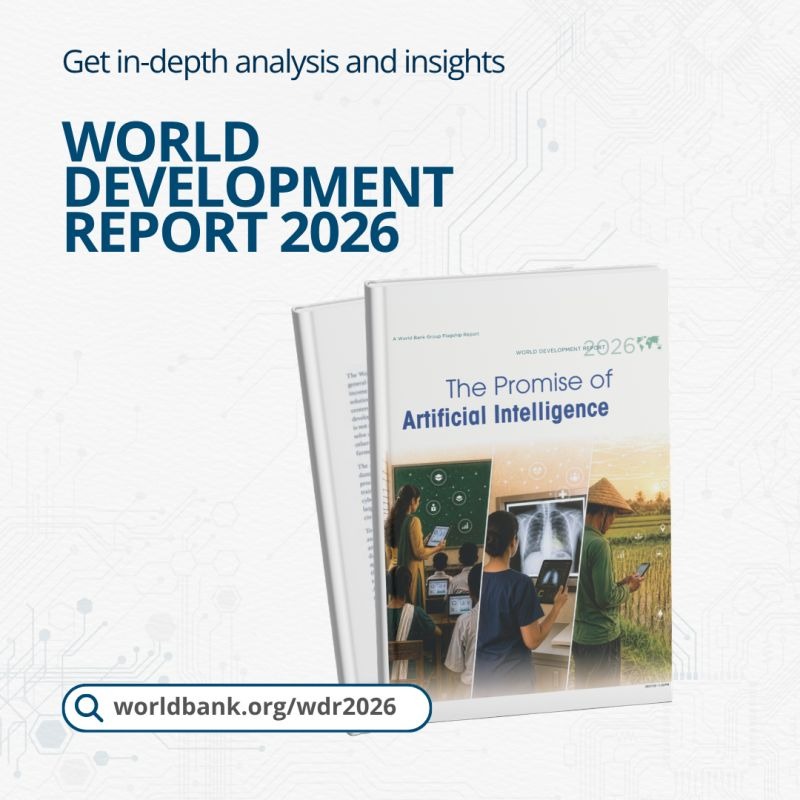
- The World Bank’s World Development Report 2026 focuses on how countries can harness Artificial Intelligence (AI) for development while avoiding excessive costs, inequality and technological dependence.
ABOUT THE REPORT
- The World Development Report (WDR) has been published annually since 1978.
- Each edition provides analysis and policy recommendations on a major development issue.
- The 2026 report advocates an “Adopt → Adapt → Advance” approach to AI.
MAJOR FINDINGS
- Automation Risk : Jobs in high-income economies are more than three times as likely to face automation risks from generative AI compared with those in low- and middle-income economies.
- Productivity : AI could raise productivity in 16%+ of existing jobs in developing economies and 18%+ in advanced economies.
- Agriculture : AI can improve farm productivity, climate resilience and resource efficiency, provided infrastructure and equitable access exist.
KEY CHALLENGES
- Developing countries may waste scarce resources by trying to build cutting-edge AI systems prematurely.
- Major AI readiness gaps exist in:
- Reliable electricity
- Internet connectivity
- Data infrastructure
- Digital skills
- Institutional capacity
- Unequal access could widen the global digital divide and increase domestic inequality.
- Excessive dependence on a few technology providers can create strategic and technological vulnerabilities.
WAY FORWARD — ADAPT–ADOPT–ADVANCE
- Adopt : Use existing AI solutions for immediate development needs.
- Adapt : Modify AI applications according to local languages, institutions and socio-economic conditions.
- Advance : Gradually develop indigenous AI capabilities where economically and strategically justified.
- Promote responsible AI through privacy protection, bias prevention and accountability.
- Strengthen digital public infrastructure, electricity, connectivity, skills and data systems.
- Build public trust through appropriate regulation and transparent AI-enabled decision-making.
WHY RELEVANT FOR INDIA?
- India can leverage AI for agriculture, healthcare, education, governance and financial inclusion.
- However, AI adoption must complement India’s efforts towards digital infrastructure, skilling and inclusive growth.
- Supports the principle of “AI for all” rather than AI-driven concentration of economic power.
