

- Syllabus: GS II – Polity | Social Justice | Reservation
- Source: TH
Context
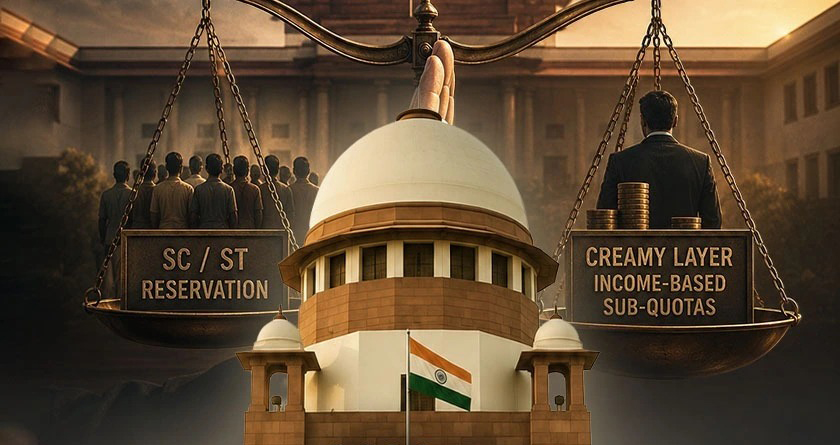
- The Union Government told the Supreme Court that the concept of a “creamy layer” should not be extended to SC/ST reservations.
- Petitions had sought exclusion of relatively advanced sections within SC/ST communities, similar to the existing creamy-layer principle for OBCs.
Background
- The creamy-layer principle was developed in the Indra Sawhney case (1992).
- It seeks to exclude relatively advanced sections from reservation benefits so that affirmative action reaches those who remain disadvantaged.
- The 2024 judgment in State of Punjab v. Davinder Singh opened the door for sub-classification within SCs/STs, bringing the question of intra-group targeting into focus.
Government’s Stand
- The Centre argued that:
- The creamy-layer doctrine has consistently been applied to OBCs.
- SC/ST reservations are not based solely on economic status.
- Their constitutional rationale is linked to historical and social discrimination, caste-based exclusion and tribal disadvantage.
- Introducing an income-based creamy layer would require a holistic review and thorough empirical study. Economic advancement does not necessarily mean that social discrimination and stigma have disappeared.
- Therefore, the OBC model cannot automatically be transplanted to SC/STs.
What is the Creamy Layer Principle?
- It originated from the Indra Sawhney v. Union of India (1992) judgment.
- Its objective is to prevent concentration of reservation benefits among relatively advantaged sections and ensure intra-group equity.
Previous Supreme Court Judgments
- Indra Sawhney Case, 1992: Upheld OBC reservation.
- Established the creamy-layer exclusion principle for OBCs.
- Distinguished affirmative action based on social backwardness from purely economic criteria.
- E.V. Chinnaiah v. State of Andhra Pradesh, 2004: Held that SCs constituted a homogeneous class for the purpose of the constitutional SC list. Did not permit State-level sub-classification within the SC category.
- State of Punjab v. Davinder Singh, 2024: A 7-judge Constitution Bench, by 6:1, overruled E.V. Chinnaiah and held that:
- Sub-classification within SCs is constitutionally permissible.
- The purpose is to ensure that benefits reach the more disadvantaged sections within the SC category.
The 2024 judgment primarily dealt with sub-classification, although Justice B.R. Gavai’s opinion strongly advocated consideration of the creamy-layer principle for SC/STs.
Constitutional Provisions
- Article 14-Guarantees equality before law and equal protection of laws. Also permits reasonable classification to achieve substantive equality.
- Article 15(4)-Enables special provisions for the advancement of socially and educationally backward classes, SCs and STs.
- Article 16(4)- Enables reservation in public employment for a backward class inadequately represented in State services.
- Article 16(4A)- Enables reservation in promotion for SCs/STs, subject to constitutional requirements.
- Article 335- Recognises the claims of SCs and STs to services and posts, while maintaining administrative efficiency.
- Article 341- Deals with Scheduled Castes.
- President specifies the SC list; Parliament can subsequently modify it by law.
- Article 342-Corresponding provision for Scheduled Tribes.
Arguments in favor:
- Unequal Backwardness- All communities within the SC/ST categories may not experience the same degree of deprivation.
- Substantive Equality- “Treating unequals equally can perpetuate inequality.” Targeting the most disadvantaged groups can make reservation more effective.
- Effective Representation- Reservation should produce meaningful representation, not merely numerical presence.
- Empirical Basis- Data can identify communities that have received fewer benefits from affirmative action.
- Intra-group Equity- Prevents repeated concentration of benefits among relatively advanced sections.
Arguments in Against
- Economic advancement does not necessarily eliminate caste stigma, discrimination and social exclusion.
- SC/ST reservation addresses historical and structural discrimination, unlike a framework based only on economic deprivation.
- A rigid income criterion could weaken the protective purpose of SC/ST reservations.
- Determining who is “socially advanced” within SC/ST communities is considerably more complex than applying a simple economic test.
- Excessive internal categorisation could create competition and divisions within reserved communities.
Way Forward
- Evidence-based policy
- Different criteria
- Protect constitutional safeguards
- Targeted welfare
- Periodic review
- Maintain social cohesion.
