

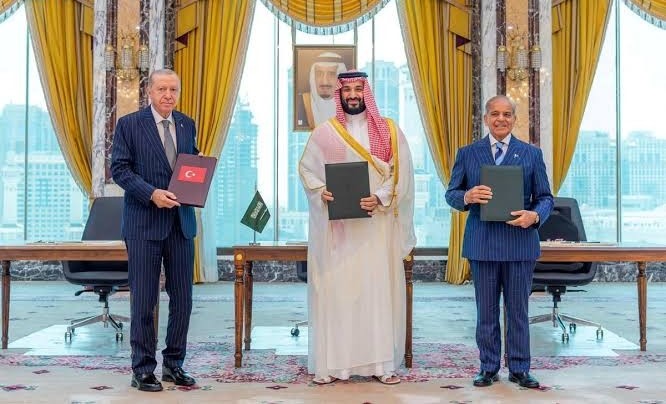
CONTEXT
- The Mecca Pact highlights the changing geopolitical dynamics of West Asia, where countries are increasingly avoiding rigid alliances.
- Strategic hedging refers to maintaining relationships with competing powers to maximise strategic options and minimise risks.
BACKGROUND
- West Asia is moving from bloc politics towards multi-alignment.
- Regional powers such as Saudi Arabia, Iran, Türkiye and the UAE are pursuing greater strategic autonomy.
- The Saudi-Iran rapprochement (2023), brokered by China, demonstrated Beijing’s growing diplomatic role.
- At the same time, the U.S. remains the principal external security partner for several Gulf states.
KEY HIGHLIGHTS
- Rise of regional agency: West Asian states increasingly make independent strategic choices.
- China’s expanding role: Economic partnerships and diplomatic initiatives have increased China’s influence.
- U.S. remains indispensable: Defence cooperation, technology and security guarantees continue to anchor U.S. influence.
- Multi-alignment: Countries cooperate simultaneously with competing powers depending on the issue.
- Economic diversification: Gulf countries are reducing excessive dependence on hydrocarbons and seeking partnerships in technology, infrastructure and investment.
IMPLICATIONS FOR INDIA
- Energy security: India can diversify its crude oil and gas supplies.
- Trade & connectivity: Stable West Asia supports India’s trade with Europe and Africa.
- Diaspora: Millions of Indians in the Gulf make regional stability directly important for India.
- Strategic autonomy: India’s engagement with Saudi Arabia, Iran, Israel and the UAE demonstrates its own multi-alignment approach.
- Maritime security: Stability around the Strait of Hormuz, Red Sea and Arabian Sea is crucial for India’s commerce.
CHALLENGES
- Continuing conflicts involving Israel-Palestine, Iran and regional actors.
- Great-power rivalry between China and the U.S.
- Risk of disruption to oil supplies and maritime trade.
- India faces the difficult task of maintaining balanced relations with competing regional powers.
- Strategic hedging can provide flexibility but may also create uncertainty and trust deficits.
WAY FORWARD
- Strengthen India’s multi-alignment and strategic autonomy.
- Deepen diplomatic engagement with all major West Asian actors.
- Diversify energy sources and accelerate the transition towards renewable energy.
- Strengthen maritime security and alternative trade routes.
- Promote India’s role as a development, technology and connectivity partner rather than merely a security actor.
MAINS EXPECTED QUESTION
Q. “Strategic hedging is emerging as the defining feature of West Asian geopolitics.” Discuss the factors driving this trend and examine its implications for India’s strategic interests. (15 Marks)
VALUE ADDITION
Keywords :
- Strategic Hedging → Multi-alignment → Regional Agency → Strategic Autonomy → Multipolarity → Energy Security → Maritime Security
One-line conclusion :
- For India, a hedging West Asia creates both opportunities and risks; sustained multi-alignment and strategic autonomy are therefore essential to protect India’s interests.
